
If you run parking and commute operations for a university, hospital, or large employer campus, you already know the signs your technology solution is out of date. Permit rules that should take five minutes require a support ticket and a two-week wait. You run important reports and audits in a spreadsheet to combine data from fragmented tools. Event days mean late nights manually reshuffling capacity. Guests pay through a workaround that nobody quite trusts. And the system you bought to fix all of this hasn’t shipped a meaningful update in over a year. If that sounds familiar, it might be time to replace your legacy parking management platform.
Most program directors put up with it because switching software sounds harder than living with the friction. But for many organizations, that calculation is changing. The gap between legacy commute platforms and the modern category is widening each and every month, and the cost of the status quo is showing up in your administrative hours, missed financial opportunities, and commuter experience.
Here’s how to think about replacing a stagnant tool, and what to look for when you do.
The hidden cost of a platform that stopped evolving
Your daily operations depend on your parking management platform. But even if it doesn’t break, what worked when you first launched a new platform several years ago might be holding you back today. As your workplace or campus grows, and the world changes, your needs evolve. Your programs should too. When the vendor stops investing in the platform, your operations get stuck and workarounds can’t keep up.
The symptoms are familiar to anyone running on a legacy system:
- Manual workarounds become permanent. No event-based capacity adjustments? Your team rebuilds the inventory by hand every game day. No citations module? Reports and audits live in a spreadsheet that nobody owns.
- Admin work compounds. Every rule change, every new permit type, every pricing tweak routes through the vendor’s support queue instead of your own dashboard. Days turn into weeks or months.
- Policy stops keeping up. Dynamic pricing, equity-based rates, and group-specific permit rules aren’t pie-in-the-sky ideas anymore. They’re how modern programs balance access and revenue. If your platform can’t support them, your policy can’t either.
- Migration only gets harder. Data compatibility gaps widen. Workflows ossify and your team forgets which policies only exist to accommodate a clunky workflow. The longer you wait, the heavier the lift.
Replacing a legacy platform like Luum that has entered maintenance mode — or any platform that’s stopped shipping updates — isn’t a nice-to-have someday. It’s a necessary step to stop the compounding overhead.
What to expect from a modern commute management platform
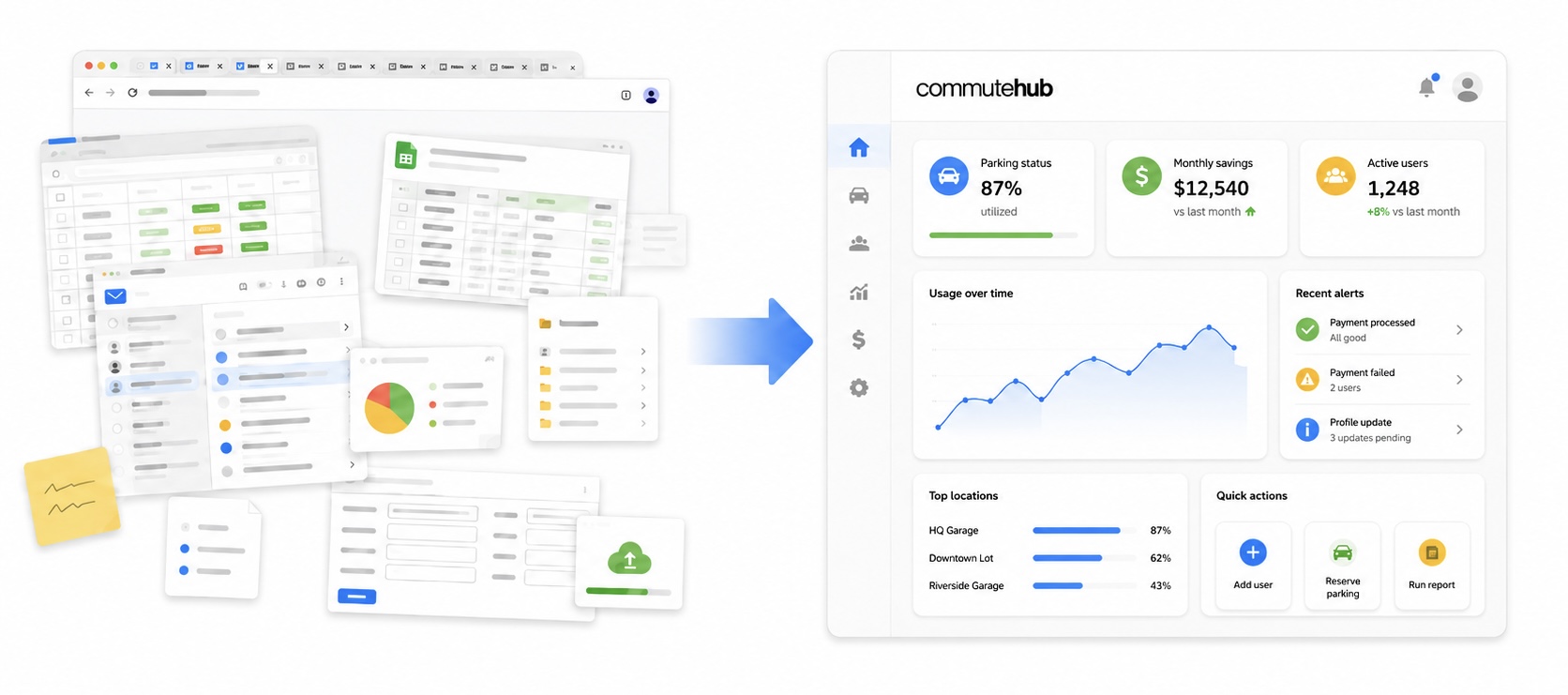
If you’re familiar with a permitting tool with other commute options bolted on, or a commute app with lightweight parking features, you’ll find the category has changed. The new standard responds to the needs of a changing workforce where hybrid schedules and daily choice are the rule rather than the exception. Any new platform you consider should integrate parking and transportation demand management because commuters want to know whether to drive, carpool, or take the train today, and if they drive, where to park and what it costs. Putting parking and other options in siloes no longer makes sense for the commuters you serve, and duplicates effort for your team while significantly limiting your leverage in managing both areas.
When you evaluate a replacement, look for these capabilities together in one platform:
Parking management that optimizes demand
- Rule-based digital permits, hourly through yearly.
- Dynamic and equity-based pricing.
- Event-based capacity adjustments.
- Real enforcement with citations and appeals.
- Guest onboarding with credit card pay.
- Waitlists.
- EV charging management.
- LPR integration.
- Built to power a modern parking operation without workarounds.
Programs that actually influence modesplit.
- Personalized recommendations driven by user segmentation.
- Multi-modal trip logging with GPS.
- Rewards, gamification, and challenges that build lasting habits.
- Vanpool and shuttle management.
- Incentives, pre-tax benefits, and subsidies.
- Guaranteed Ride Home administration.
A platform built for the next five years, not the last ten.
- AI and natural language interfaces.
- Visual workflow builders.
- Multi-channel notifications across email, push, and in-app.
- Open APIs and MCP.
- Complete audit trails.
- White-label branding.
This combination is rare. Some vendors do half of this well and the other half poorly, or they go broad at the surface and fall short for most organizations. The platforms worth evaluating are the ones that treat parking optimization and transportation demand management as a single problem. Parking policy reinforces commute behavior, and commute behavior reshapes parking demand. Managing them together gives you leverage you can’t get from either one on its own.
Why timing matters more than you think
You may want to put off the effort and expense of switching, but the real costs of staying on a stagnant tool add up:
- Every month on a stalled platform is a month commuting drags down the overall employee experience, even as your team is working harder than ever to smooth it over.
- Every new permit type, location, pricing tier, or new transportation program you bolt onto a legacy system makes the eventual migration harder.
- Planning ahead now is safer than waiting until something breaks and the current vendor will no longer fix it. Don’t wait until a crisis to schedule IT resources and contract with a new vendor.
By starting the switch now, you lock in self-service control, modern UX for their commuters, and a transition on your terms. If you wait, you inherit a harder migration and a wider feature gap when you eventually replace the outdated parking management platform.
What to look for in a partner
When you are ready to start evaluating replacements, don’t forget to vet the teams behind them too. Your mission-critical parking and transportation operations are too important to entrust to an unprepared partner.
Here are some questions to ask a potential vendor:
- Do they release improvements regularly, or has the roadmap stalled?
- Is there an active user community shaping the product?
- Can they show a proven, structured migration path with zero downtime for your operations?
- Will you have a dedicated customer success team and onboarding support from day one?
- Do they have robust training and enablement resources and a well-maintained knowledge base for the product?
- Have they done this before, at scale, for organizations as complex as yours?
CommuteHub by RideAmigos can answer “yes” to all of them and if you have a legacy parking management and/or TDM platform like Luum, we are already working with customers like you who’ve transitioned from the same software and hit the ground running on day one. And the day you make the switch is only the beginning. CommuteHub is the only platform on the market that combines full parking management with a complete transportation demand management solution. Our active roadmap is driven by research and development, and a highly engaged user community that includes some of the most recognized parking management and TDM programs in North America. Once you go live, our customer success team will stay with you and make sure your platform stays in sync with your needs for the long term.
Ready to preview what a seamless transition to your futureproof CommuteHub looks like? Check out our product comparison and get the free conversion kit.