

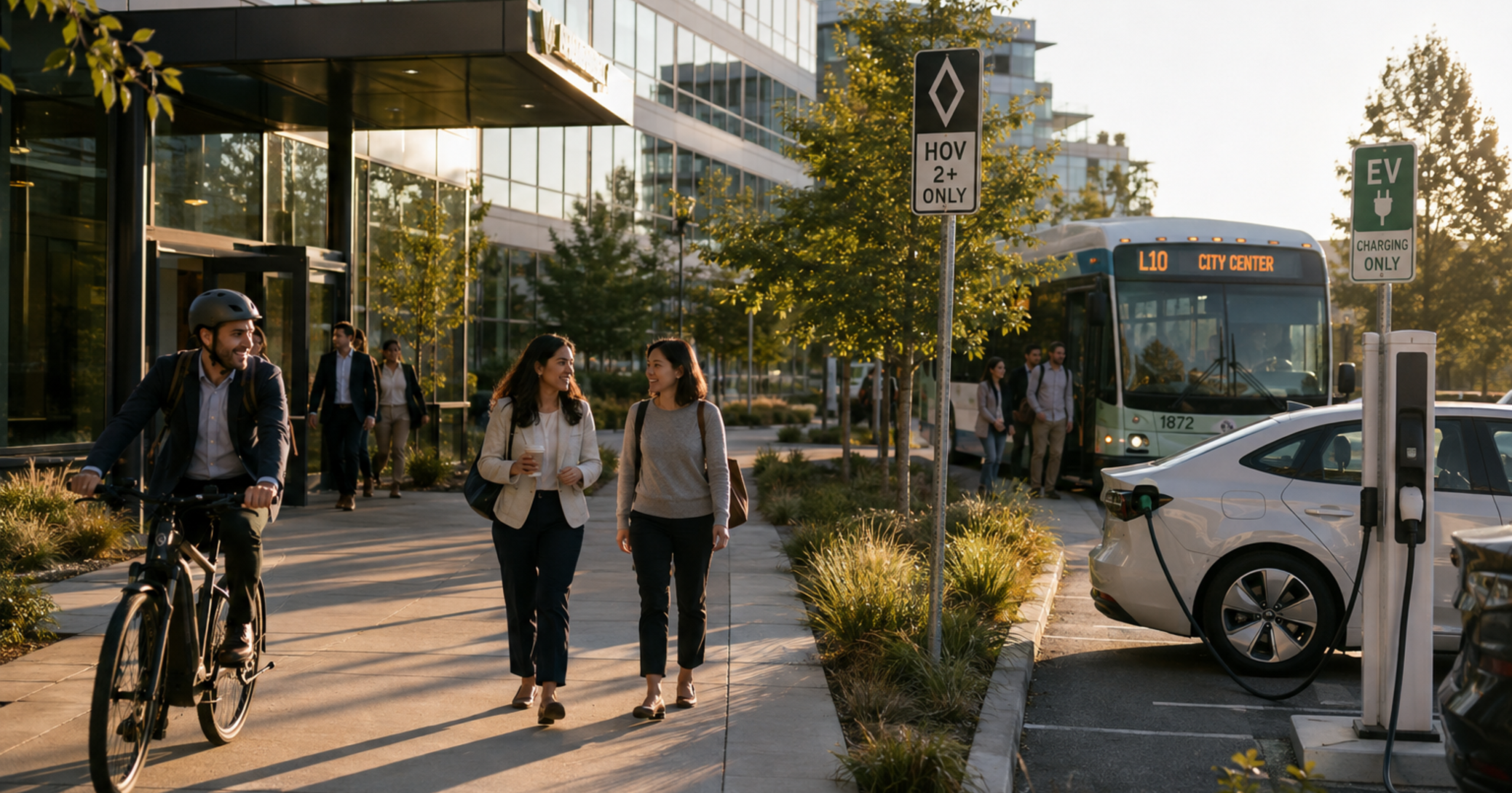
In the workplace, transportation demand management (TDM) is the strategic practice of reducing the number of solo-driving commutes employees make. It seeks to influence commuters’ transportation choices through a combination of policy, incentives, infrastructure, and technology.
TDM isn’t about increasing capacity. It’s about making smarter use of the facilities and infrastructure your organization already has. At a systems level, TDM touches everything from human resources and environmental compliance to facilities and operations management.
Employers approach TDM from many different angles. For some, it’s about improving the commute experience or managing parking and infrastructure costs. For others, it’s about meeting Scope 3 reporting requirements or ESG targets. Organizational branding, which impacts the way an employer is perceived in the labor market, is another common motivator.
In the past, employers relied heavily on fragmented systems built around manually issued surveys, HR administration, internal reporting tools, and tracking spreadsheets to manage their TDM programs. Today, specialized software platforms centralize and automate virtually all of these functions.
However, there’s one very important detail no TDM tech platform can handle: understanding the nuances of your organization, and designing a transportation demand management strategy that meets you where you are. The strategies that work also differ by organization size, industry, and operating context.
To shape a winning program, you need two things: a starting point, and a framework. This comprehensive resource provides both, explaining all the foundational essentials you need to design and refine a TDM program that works for everyone in your organization.
Perhaps most importantly, TDM directly affects how employees experience their daily commute. Understanding how this looks in practice is a great place to start.
TDM as a workplace experience strategy
Whenever an employee is physically present in the workplace, their day starts and ends with a commute. As a result, commuting directly and actively shapes an employee’s mood, productivity, job satisfaction, and their perception of you as an employer.
Yet, commuting is fundamentally changing. The Texas A&M Transportation Institute’s 2025 Urban Mobility Report tracked a statistically significant 5% shift in congestion-related delays away from traditional peak periods and into off-peak hours, relative to traffic patterns in 2019. The report also found:
- A notable increase in midweek clustering of traffic volumes
- Sizable reductions in Friday traffic
- More even traffic volume distributions across working hours
- Less overall traffic concentration in traditional peak periods
So, what changed between 2019 and 2025? The rise of remote and hybrid work.
In January 2026, the HR research firm Robert Half found that 88% of surveyed employers in the United States offered some form of direct support for hybrid work arrangements. Before the pandemic, hybrid options were a nice perk. Now, they’re widely expected to be available by default.
The rise of hybrid work has disrupted established ways of thinking about commute management. It has also introduced more logistical complexity and nuance, since static approaches built around “Monday to Friday, 9 to 5” no longer match on-the-ground realities.
Put simply, your transportation demand management strategy has to be responsive and adaptable to changing commute patterns. From a conceptual standpoint, this means it should include:
- Personalized commute planning tools that allow commuters to surface transportation options that meet their individual needs
- Multimodal trip planners that make alternatives to driving easily accessible and practical for regular use
- Real-time wayfinding and parking availability to reduce or eliminate arrival friction
- Guaranteed ride home programs that remove the risk barrier from ditching the predictable security of the solo drive
Your strategy should also address the concept of trip reduction. The old TDM adage that the best commute is the one that’s never made is arguably truer now, in the age of hybrid work, than ever before.
Incentive programs and gamification
Transportation demand management programs work best when they include an engagement engine. The most thoughtfully designed TDM strategy under the sun won’t move the needle if commuters don’t get involved.
Incentives and gamification elevate participation rates: Incentives provide rewards, and gamification makes alternative commuting fun.
The behavioral science evidence here is clear: Incentives are very good at prompting commuters to change their modal choices. This has been shown in studies by the Massachusetts Institute of Technology, the Bay Area Rapid Transit (BART) system, the University of Groningen, and many other research groups.
While there’s no limit to how creative you can get with gamification and incentives, organizations often find it easiest to stick with simple, proven techniques. Points-based rewards programs are one common and highly effective example.
Here’s how they typically work:
- Employees participate by logging trips made with approved alternatives to driving. These can include public transit, vanpooling, carpooling, walking, biking, and any other modes you wish to support.
- Commuters earn a predetermined number of points every time they complete a verified trip using an approved alternative mode.
- Points accumulate until the commuter redeems them for prizes or perks, like merchandise, gift cards, event tickets, transit credits, or anything else you care to offer.
- Leaderboards and challenges add a socially engaging dimension of friendly competition that sustains engagement beyond the initial launch.
You can level up your incentive and gamification program with special bonuses like grand prize draws. This approach tends to work best when matched with a mechanism that gives more draw chances to commuters who log the most alternative trips.
Four specific elements make gamification and incentive programs succeed:
- Verification. Award points only for logged, verified trips. Self-reporting is far less credible, and people may disengage if they feel the system can be gamed.
- Premium rewards. Make the prizes you offer genuinely appealing to your employees. If they feel generic or low-value, your commuters won’t care — and they won’t participate.
- Flexible incentive structures. One-size-fits-all incentive programs tend to leave engagement potential on the table. Instead, tailor your rewards so they’re targeted to specific commuter populations, worksites, or transportation modes. For added effect, set up your incentives so they provide a solution to the specific participation barriers targeted commuter groups face.
- Social recognition. Earned status, public leaderboards, and team-based challenges add a social engagement dimension to the program. They also help elevate individual commuting behaviors to the level of a shared organizational value, which in turn inspires wider and more enthusiastic buy-in.
Incentives and gamification also add a critically important dimension to the administration side of the program: When participants log trips, they generate verifiable behavioral data. This is crucial if your organization participates in voluntary or mandatory Scope 3 emissions reporting or any other compliance programs.
Organizations often have limited resources to spend in these areas, and that’s fine. There are tons of ways to make incentive programs work on a limited budget.
TDM and parking management
Many organizations first encounter the concept of transportation demand management after seeking a solution to a parking problem. Common examples of these problems include:
- Organizational growth has outpaced your ability to meet parking demand
- Hybrid work schedules have led to unpredictable demand and variable supply
- Infrastructure or maintenance costs are rising out of control
- Employee complaints about parking friction
- Inefficiencies leave some parking zones overflowing while others sit half-empty
These issues reveal a lesson that many employers miss until it causes issues: When parking is free and available without limit, driving becomes the default behavior. Demand rises and stays elevated, and your facilities costs rise — taking your carbon footprint with it.
Organizations face these types of challenges with such regularity that parking management has become a major TDM subfield. Transportation demand management professionals have developed an entire set of strategies designed to relieve parking burdens by reshaping commuter behavior.
Here are some alternatives to free parking to consider, depending on your organizational needs:
Daily choice permitting
Daily choice permitting is a simple concept with powerful impacts. Instead of issuing fixed annual or monthly parking permits, use a daily reservation system. This strategy helps you:
- Control and optimize demand
- Improve the commuter experience
- Retain flexibility for managing surges and special events
- Generate data-driven insights into commuter behavior and preferences
It also prompts commuters to revisit their transportation decision every time they travel to work. This makes it easier to inspire behavior change, especially when you pair daily choice permitting with pricing policies and capacity caps.
Parking pricing and capacity caps
Attaching a cost to parking is one of the most effective ways to get commuters to reconsider their modal choices. Pricing doesn’t have to be punitive to have an impact. It only needs to do just enough to get commuters to seriously reconsider their transportation choices.
Capacity caps can come in the form of hard caps on parking supply, daily limits on permit issuance, or zone-based maximums. However you decide to use them, capacity caps always work the same way: They send scarcity signals to commuters, making driving less automatic and guiding commuters to alternatives.
Cash-out programs
Cash-out programs deliver direct payments to commuters who agree to give up their parking access. They give commuters a powerful incentive for opting in — one that naturally redirects them toward smart transportation alternatives.
Parking cash-outs are best used as part of a comprehensive travel reduction program that makes alternative modes visible, accessible, and practical for regular use. They also tend to work best when they incorporate a few strategic features:
- Use priced parking to create a financial “swing” effect. That way, the commuter benefits not only from the cash-out payment, but also from the savings on daily parking costs.
- Limit parking supply so scarcity prompts commuters to seriously consider opting out. Capacity caps are an ideal complementary strategy.
- Provide strong support for alternatives like public transportation, active commuting, and ridesharing. Consider subsidizing transit passes, adding on-site infrastructure for active commuters, and consider connecting your worksite to major commuter stations with vanpools.
- Make it easy to opt in and out. Don’t force your commuters to make a long-term commitment to something they haven’t tried and can’t reverse. Instead, offer daily or weekly opt-ins so your employees retain flexibility and control.
When issuing payments, you can distribute cash-outs separately or integrate them with payroll. Both approaches have advantages: Separate distributions act like a kind of financial bonus that reinforces the program’s value in the mind of every participating commuter. Payroll integrations make things easy, seamless, and efficient.
However you choose to proceed, know that cash-out programs are proven to work. Studies have shown that they reduce parking demand by up to 45%.
HOV and EV prioritization
Giving preferential treatment to high-occupancy vehicles (HOVs) and electric vehicles (EVs) also helps shift commuter behaviors. Give HOVs and EVs priority spaces, make those spaces visible, and back them with simple but credible enforcement.
When managing access to EV charging stations, encourage turnover so commuters aren’t treating charging stations as parking spots. Set and enforce time limits, or use pricing to get EV drivers to self-regulate their charger usage. That way, you prevent all-day occupancy while preserving fairness.
Commuter benefits and how they interact with TDM programs
Pre-tax commuter benefits are powerful behavior-shaping tools. These programs are available for qualifying transportation fringe benefits as defined by the Internal Revenue Service, meaning they can help commuters cover:
- Public transit passes
- Qualified parking expenses
- Vanpooling and ridesharing
- Active commuting costs
When used strategically, commuter benefits become targeted levers that encourage mode share, reduce parking demand, and generate data for reporting and planning purposes. You can encourage these outcomes by using strategies like:
Mode-weighted design
Instead of offering every commuter the same subsidy packages regardless of how they travel, consider prioritizing specific transportation modes to reflect your organizational priorities.
For example, suppose you’ve identified active commuting and vanpooling as being particularly practical for your commuter base. You could then offer daily micro-reimbursements or wellness credits to commuters who walk or bike, and fund vanpool subsidies at a higher per-employee rate to encourage stronger uptake.
From there, you could reduce, cap, or eliminate parking subsidies. That way, the policy design actively shapes the TDM result.
Integrated mobility wallets
With integrated mobility wallets, you can use a single system to consolidate all your benefit distributions. That way, your transit subsidies, biking reimbursements, vanpool supports, and cash-outs are all handled the same way, in the same place.
Your commuters can then use their mobility wallet to:
- Pay for parking
- Claim subsidies and reimbursements
- Receive cash-out payments
As with other transportation demand management principles, this strategy prompts commuters to consistently engage with alternatives to driving while checking off your internal administrative, compliance, and tracking boxes.
TDM, sustainability, and compliance
Employee commuting falls under Scope 3, Category 7 of the GHG Protocol. It’s an area where regulatory pressure is building:
- California’s SB 253 will require large companies to report Scope 3 emissions starting in 2027
- The EU’s Corporate Sustainability Reporting Directive extends similar requirements to U.S. companies with European operations
- State-level trip reduction mandates in Washington, Oregon, and elsewhere add further compliance obligations for specific industries and employer sizes
TDM is the primary tool for prompting the mode shift and verified behavior change you need to generate auditable reductions in your Scope 3 emissions. If your organization participates in voluntary or legally mandated Scope 3 emissions reporting, you need compliance-grade transportation demand management infrastructure.
That means:
- Verified trip logs with integrated mode confirmation. Annual surveys and self-reporting programs don’t produce defensible emissions data.
- Continuous data collection that builds a living emissions inventory rather than a point-in-time snapshot.
- Multi-site reporting that accounts for hybrid schedules, remote days, and workforce changes.
- Compliance report generation tools aligned with GHG Protocol Category 7 standards and any state mandates that apply.
By building this infrastructure now, you’ll earn and retail a measurable advantage as reporting requirements become active and continue to tighten.
Best practices for building an effective TDM program
Transportation demand management works best when it’s built on a foundation of sound and proven design principles. To that end, here’s a reference table covering essential TDM best practices in a “dos and don’ts” format:
TDM Best Practices for Employers | ||
|---|---|---|
| TDM Concept | Do: | Don’t: |
| Workplace experience | Personalize commute options by employee location, schedule, and type Integrate guaranteed ride home programs to remove the risk barrier from alternative modes Treat trip reduction as an active program goal, not a passive byproduct Update your offerings as hybrid schedules and commute patterns evolve | Rely on a static, one-size-fits-all commute portal Assume that making alternatives available is enough — commuters need active support and nudges Ignore the return-to-office transition as an opportunity to advance TDM objectives |
| Incentives and gamification | Award points only for verified, logged trips Offer genuinely valuable rewards that reflect what your commuter population actually wants Configure incentive structures to target specific segments, worksites, or behavior gaps Use challenges and leaderboards to build social momentum around the program | Allow self-reporting without verification, as doing so undermines program credibility and produces unreliable data Launch a one-time challenge and call it a program Offer generic or low-value rewards Ignore the behavioral data that trip logging generates |
| Parking management | Use daily choice permitting to reopen the commute decision every morning Pair pricing and capacity caps with credible alternative mode support Design cash-out programs with daily opt-in flexibility, a financial swing effect, and strong alternatives in place Give HOV and EV commuters visible, enforced priority Disaggregate occupancy data by site, zone, and day | Offer free, unlimited parking and expect other TDM strategies to compensate Introduce pricing without building awareness of and access to alternatives Use set-and-forget monthly permits that auto-renew regardless of usage Manage multi-site parking from disconnected systems that can’t share inventory data |
| Commuter benefits | Weight subsidies toward higher-impact modes rather than distributing them neutrally Consolidate all benefit types into a single mobility wallet Automate pass requests and approvals to reduce administrative overhead Tie benefit participation to trip logging so utilization generates behavioral data | Treat commuter benefits as a static HR checkbox Subsidize parking at the same rate as or more generously than sustainable alternatives Allow benefits to operate in a silo disconnected from TDM program goals and compliance reporting Let low awareness drive low participation; instead, visibly integrate benefits alongside your other commuter programs |
| Sustainability and compliance | Use verified trip logging with mode confirmation as your primary data collection mechanism Build a continuous, living emissions inventory rather than relying on annual surveys Account for hybrid schedules and remote days in your baseline methodology Generate compliance reports aligned to GHG Protocol Category 7 standards Start building your data infrastructure before reporting requirements make it mandatory | Rely on self-reported annual commute surveys for compliance data — they won’t withstand audit scrutiny Treat Scope 3 Category 7 as a reporting obligation rather than a behavior change opportunity Apply a single emission factor to your entire workforce without accounting for site, mode, or schedule variation Wait for regulatory deadlines before building your reporting infrastructure |
Bringing it all together with CommuteHub, a transportation demand management platform built for employers
Every one of these TDM strategies, from personalized commute planning and gamified incentive programs to parking cash-outs, mobility wallets, and Scope 3 compliance reporting, works better when it operates from a single, connected platform. That’s precisely what CommuteHub delivers.
CommuteHub is purpose-built for organizations that are serious about making commuting better and more sustainable. It serves employers of all types and sizes, including:
- Corporate campuses
- Health systems
- Airports
- TMOs, MPOs, and other public agencies
- Educational institutions
CommuteHub centralizes every element of the commute program in one place. More than 515,000 commuters currently use CommuteHub to log trips, earn rewards, and access transportation options across more than 13,000 employer networks. Meanwhile, administrators save over 100 hours per TDM program thanks to automated data validation, approvals, fraud detection, and outreach.
Across every organization type and TDM objective, CommuteHub turns complexity into clarity by connecting data, automating workflows, and delivering personalized commuter support.
If you’d like to see how CommuteHub can modernize your organization’s commuting experience and support your specific TDM goals, contact our Team to arrange a personalized platform demo.