
Educational institutions, health systems, and corporate campuses often manage their employee and visitor parking separately. Some organizations go as far as using totally different workflows and administrative teams for each user group. Both user categories share the same parking infrastructure, but siloed setups mean that neither system knows what the other is doing.
That information gap creates problems. Parking inventory can sit idle on one side while the other pushes full capacity. Enforcement becomes inconsistent, and occupancy data tells only part of the story. Meanwhile, costly inefficiencies steadily accumulate.
Visitor management software that connects both user populations in a unified platform does more than just reduce friction. It turns parking inventory into a dynamic asset you can monetize and optimize.
At their core, employee-guest parking inefficiencies arise from an information gap. Intelligent insights are the key to bridging that gap and finding solutions that work for everyone.
Why campuses manage employee and guest populations separately in the first place
Separated employee and visitor parking didn’t become the norm by accident. It arose from the fact that these two user populations have genuinely different demand profiles and facility access needs.
Employee parking is predictable by design. It uses permits, eligibility rules, and zone assignments to create a structured system built around a fixed and known user population. Visitor parking, by contrast, is inherently variable. It fluctuates by day, season, event schedule, and facility type.
Under legacy systems, managing these two user populations with the same rules framework would have created more problems than it solved. Then, parking management software platforms came along, offering precision tools and deep, data-driven insights. These platforms were a game-changer. But so was something else: the rise of hybrid work.
Hybrid work schedules made on-site employee attendance variable. As a result, the easy predictability of employee parking demand was gone. Employee parking zones that were previously full became subject to day-to-day variability and underoccupation.
Visitor demand, meanwhile, has never been simple. Guests have always arrived with different access needs, dwell times, and wayfinding requirements.
If you’re still using legacy systems to manage demand that is now inherently dynamic on both sides, you’re leaving value on the table. You could be using visitor management software as part of a comprehensive parking program to improve efficiency, deliver a better user experience, and generate more revenue.
The hidden operational costs of siloed parking management
Siloed employee and visitor parking causes several obvious problems: visitors circling for spaces, employees displaced from their zones, and support requests piling up. Yet, the less visible costs can be even more burdensome. These include:
- Inventory waste. Lower-attendance days are part and parcel of the hybrid work landscape. On these days, employee spaces may sit idle while visitor spaces teem with demand. In siloed systems, the visitor side can’t take advantage of the employee side’s slack. That leaves your entire system operating well below its potential.
- Administrative inefficiency. Separate systems mean two sets of rules, two enforcement regimes, two data streams — and two teams managing the same assets from opposing angles. That creates cost overhead, and that overhead scales with organizational complexity.
- Incomplete data. Without unified visibility into both user populations, you’ll be making capacity decisions based on an incomplete view. That makes it virtually impossible to optimize your parking management system or solve efficiency challenges.
- Uneven enforcement. When employee and visitor systems don’t communicate, enforcement gaps can arise. These gaps can erode user trust and create frustrating inconveniences while making it difficult to identify and act on violations.
These costs don’t announce themselves. Instead, they quietly erode utilization efficiency, revenue potential, and the end user’s parking experience.
How unified parking management works in practice
Visitor management software readily adapts to today’s operational realities while delivering precise solutions to siloed inefficiencies. It doesn’t eliminate the distinctions between employees and visitors. Instead, it manages each group intelligently within a unified platform.
This makes a major operational difference. Administrators gain real-time occupancy visibility across all populations and zones. If on-site employee attendance drops one day, you gain the valuable ability to reassign that capacity to visitors without any need for manual intervention. This alone can help you extract more value from your parking infrastructure.
As this happens, differentiated rules for each user group remain intact. Visitor-specific workflows integrate directly with the employee-side infrastructure, providing guests with:
- Pre-registration and self-service features fully integrated with access controls
- Real-time wayfinding that routes visitors to available spaces without displacing your employees
- Automated inventory management and time-based visitor permitting
These features deliver two powerful benefits: a complete, unified occupancy picture, and a parking ecosystem that works seamlessly for every user.
Special considerations for health systems
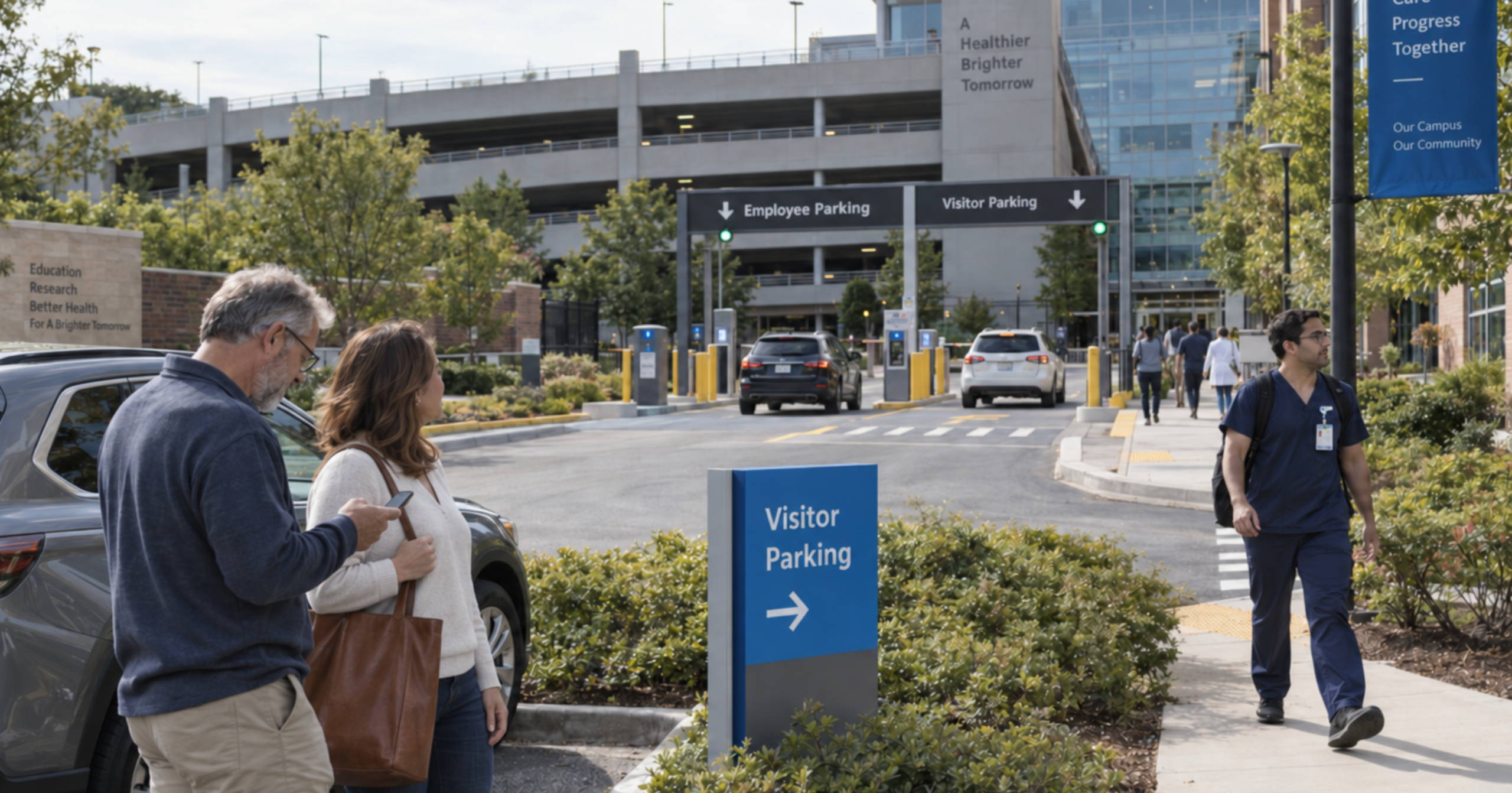
In healthcare settings, many of your visitors will be patients. They’re often unfamiliar with your campus, racing against the clock, and arriving under stress. This creates a higher-stakes operating environment that visitor management software can help you manage with purpose-built tools.
These include:
- Reservation systems that show arriving visitors exactly where to go
- Priority access options for visitors with mobility limitations or time-sensitive needs
- Parking validations that integrate with patient check-in systems
These features eliminate frustrating and stressful parking experiences while fully protecting staff access. They also seamlessly transfer to other institutions with high-demand windows, like university campuses dealing with surges on move-in weekends, graduations, and other large campus events.
CommuteHub: Visitor management software purpose-built for campus complexity
Managing distinct populations on shared infrastructure is a challenging issue that demands a sophisticated solution. The CommuteHub platform delivers that solution in the form of a unified, user-friendly software suite that solves both administrator-side and user-side parking challenges.
Administrators get access to:
- Real-time occupancy data
- Visibility across all parking zones and user groups
- Automatic, demand-responsive inventory reallocation
- Unified enforcement backed by license plate recognition (LPR) integrations
- Consolidated data reporting and analytics features
Employees and visitors benefit from:
- Guaranteed access to protected parking zones
- Pre-registration and self-service features
- Real-time wayfinding
- Check-in system integrations
If you’re ready to run your permitting, reservations, access controls, enforcement, and analytics through a single, intelligently managed ecosystem, CommuteHub can help.