
Commuter engagement programs often launch with lots of energy and excitement, only to plateau within months. Participation quietly erodes, trip logging drops off, and the program recedes into the background and stops serving the employees it was designed to help.
Why? It comes down to the fact that commuting is a deeply habitual behavior. Commuters make their transportation choice, then automatically repeat it. A program that doesn’t actively disrupt that habit loop at opportune moments, and with the right incentives, is destined to underperform no matter how good it looks on paper.
Here’s what actually moves the employee commute engagement needle:
Make the first experience frictionless and personally relevant
The single highest-leverage moment in any commuter engagement strategy is onboarding. Employees who don’t find immediate, personally relevant value in their first interaction with the program rarely come back.
When an employee opens a commute platform for the first time and sees options that are genuinely relevant to their life, they engage. When they see a generic menu that requires effort to interpret, they don’t.
Put more simply: Generic program introductions tend not to work. Avoid low-effort, generalized resources like an email linking commuters to a resource page or providing a list of local public transit options.
Instead, aim for personalization: Show commuters alternatives that connect their home address to their worksite. That way, they can see for themselves what alternatives are available specifically for them, and they’ll become far more likely to use them.
For more, consult this resource on marketing your employee commuter program successfully.
Use verified incentives, not awareness campaigns
Awareness campaigns were once the bread and butter of employee commute engagement strategies. However, the cold hard reality that commute managers have learned is that “transit month” promotions, sustainability pledge drives, and informational emails have low conversion rates. This is because awareness campaigns ask commuters to change specific habitual behaviors for abstract reasons. Results don’t typically follow.
Verified incentive programs work differently. They attach a tangible, immediate, and meaningful reward to a specific, confirmed action.
The verification element is critical. Programs that award points for self-reported trips generate weaker behavioral data and erode trust when employees realize the system can be gamed. GPS-verified trip logging, tied to a modal confirmation, creates a credible record that helps commuters earn rewards. It also builds an auditable record for your sustainability and compliance documentation.
Incentive structure matters too. Tiered rewards that unlock new benefits as employees accumulate trips keep engagement going. Grand prize draws weighted toward frequent participants add an element known as variability, which is a well-documented behavioral mechanism for maintaining participation over time.
Build social momentum through challenges and peer visibility
Individual incentives change behavior, but usually at the margins. When you add a visible social element, you can change it at scale.
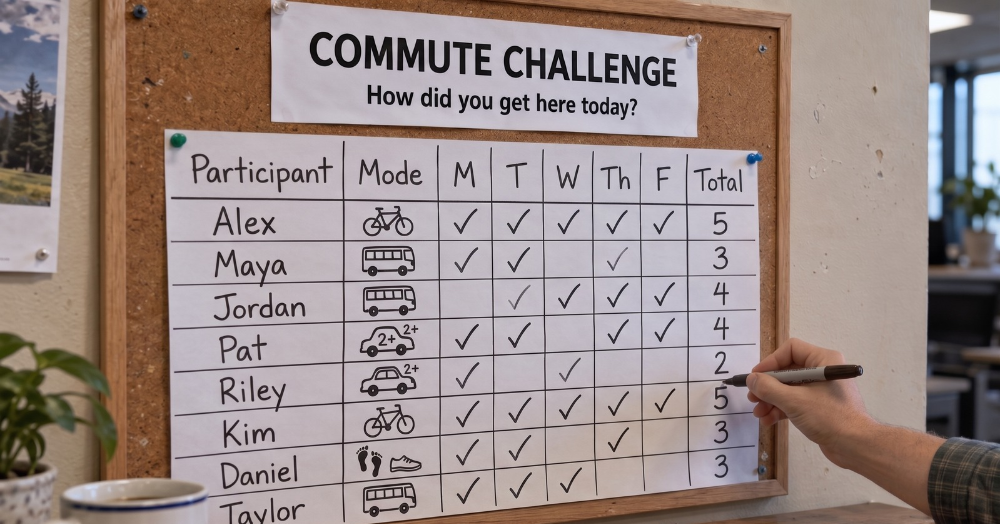
Time-bounded commuter challenges, for example, create social proof and peer accountability that standing programs rarely generate. An employee who wouldn’t enroll in a commute program on their own will often participate when their team is competing on a leaderboard. To this end, you can use:
- Departmental competitions
- Campus-wide car-free weeks
- Seasonal mode-shift campaigns
The commuter engagement gains that challenges deliver add up in a specific and useful way: Employees who log trips during a challenge establish new transportation behaviors while also getting used to using a commuter management platform. As both become habitual, you have the ingredients you need to retain program participation once the challenge ends.
Remove the contingency barrier
A lot of employees who express interest in changing commute modes never actually make the switch. This isn’t because alternatives are unavailable. Instead, it’s because driving feels like the only option that guarantees they can handle an unexpected situation.
Guaranteed ride home (GRH) programs address this head-on. By providing a pre-approved, easy-to-request ride home for emergencies, they remove the psychological barrier that keeps otherwise-willing employees tethered to their cars.
Meanwhile, actual utilization rates for GRH programs are typically very low. That means they don’t cost much to run — especially when compared to the behavior change they can unlock.
CommuteHub delivers digital tools that drive commuter engagement
Personalized onboarding, verified trip incentives, challenge and leaderboard tools, and guaranteed ride home administration all require connected infrastructure to deliver results at scale. That’s precisely what CommuteHub provides.
CommuteHub’s AI-powered personalization engine surfaces commute options tailored to each employee’s location, schedule, and eligibility from day one.
Verified GPS trip logging feeds an unlimited incentive program architecture complete with customizable rewards, status tiers, and functionality for grand-prize draws built right in.
Automated engagement journeys, like push notifications, in-app prompts, and email sequences, keep participants active between challenge cycles without the need for manual outreach.
Guaranteed rides home are administered end-to-end within the same platform, making GRH easy to offer, easy to request, and easy to document.
Ready to learn more? Talk to a CommuteHub expert to arrange a personalized demo today.