
If you’re managing a large commuter population, you’re probably navigating three competing priorities simultaneously:
- Employees need reliable parking access
- Finance teams need controlled, predictable costs
- Sustainability teams need documented, measurable progress toward emissions and trip reduction goals
If you’re treating these as three separate issues in need of three separate solutions, chances are you’re losing ground on at least one of them. Rethinking your parking management strategy is the key to bringing all three under balanced control.
Employee access, cost management, and sustainability don’t need to compete with each other. Instead, you can get them to reinforce and complement each other by organizing your thinking around:
- Understanding why these three priorities often conflict under traditional parking management models
- How real-time data solves the employee access issue without adding supply
- Using flexible pricing to connect cost control and commuter behavior
- Leveraging parking policy as a sustainability tool
- Bringing it all together under an integrated approach
Start by looking at why commuter access, cost control, and sustainability have traditionally been treated as competing priorities.
Why access, cost, and sustainability conflict under traditional parking management models
Under legacy parking management strategies, access, cost, and sustainability considerations tend to be a source of structural tension. This is because the tools traditionally used to manage them work against each other.
Let’s start with parking. Monthly or annual permits have been the default parking access strategy for a long time, but they create a problem:
Permits lock in demand regardless of actual attendance.
If permit holders don’t show up, parking inventory sits idle. When the opposite happens, parking facilities overflow with excess demand. On low-attendance days, parking inventory is an unmonetized inefficiency. On high-attendance days, it’s a chaotic pain for everyone.
So, for traditional approaches to parking access, the problem can be put like this:
Your parking facilities can end up underused or overwhelmed, depending on the day.
Meanwhile, legacy cost management models rely on tools like:
- Periodic audits
- Annual reconciliations of permit revenues
- Manual utilization counts
These strategies don’t produce actionable insights. They produce snapshots in time that may or may not accurately reflect the day-to-day reality on the ground. There’s no mechanism for real-time adjustment, and there’s no connection between the cost data your finance team sees and the behavioral levers that could change it.
In summary:
Legacy cost management processes measure yesterday’s reality without giving organizations the tools to change it tomorrow.
Next, consider sustainability. In this arena, the issue has historically been that organizations don’t connect their sustainability programs to parking management. Instead, sustainability goals operate parallel to parking rather than running through it to help force change.
In other words:
Driving remains the path of least resistance when sustainability goals and parking policies are disconnected.
You can heavily promote transit use, active commuting, and other alternatives, but little will come of it if your parking policies don’t prompt commuters to make a modal decision with every trip to work.
Real-time data solves the access issue without increasing supply
When running into capacity-related parking problems, organizations tend to assume undersupply is the issue. In many cases, the actual dynamic has less to do with supply and much more to do with how your existing supply is allocated and managed.
Permit-to-space ratios might look great on paper but fail in practice on days when actual on-site attendance departs from your projections. The Campus Services team at Oregon Health & Science University (OHSU) discovered this in 2021, when they did a usage audit of their 2,261 active annual permits. OHSU found that only 938 of those permit holders actually parked on the busiest single day and that 359 permit holders never parked at all.
The gap between the number of permits issued and the number of cars that actually park is known as “phantom demand.” Phantom demand consumes supply in theory but not in practice, creating potentially massive parking management inefficiencies.
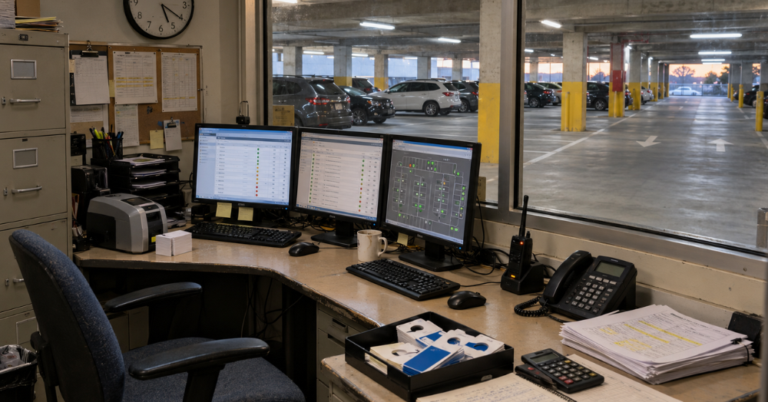
Real-time occupancy data closes the phantom demand gap. When you can look past permit allocation to see actual utilization by zone, day, and time, you can make inventory decisions based on what’s actually happening instead of relying on theoretical data.
Daily parking reservation systems take this logic even further. When every employee reserves parking only for the days they actually plan to come to work, phantom demand vanishes. Inventory counts become accurate, and everyone who needs to park on a given day can find a space.
The takeaway: You probably don’t need more capacity to improve employee parking access. Instead, you just need better information and smarter parking management architecture that reflects actual commuter behavior.
Connect cost control and commuter behavior with flexible pricing
Cost is a powerful lever for influencing commuter behavior. You don’t have to be punitive. You just need to create a pricing nudge that prompts every commuter to consider their modal decision whenever they’re heading to work.
By putting a price on parking, you can achieve two desirable outcomes with a single action: generating a new revenue source and effectively managing parking demand. However, there’s a catch: Organizations often apply static rates because they’re easier to track — especially with legacy tools. Static rates generate revenue, but they do nothing to manage demand.
With static rates, there’s no behavioral signal. There’s nothing to influence how often commuters drive or which parking zones they use. Under that framework, demand tends to concentrate in the most convenient zones and parking administrators have to rely on enforcement and waitlisting to manage the aftereffects.
Flexible, demand-responsive pricing changes the equation entirely. It’s based on four core principles:
- Wage-based tiers make daily parking affordable for lower-earning employees while recovering costs from higher earners. This distributes cost burdens equitably, making the system more fair to everyone.
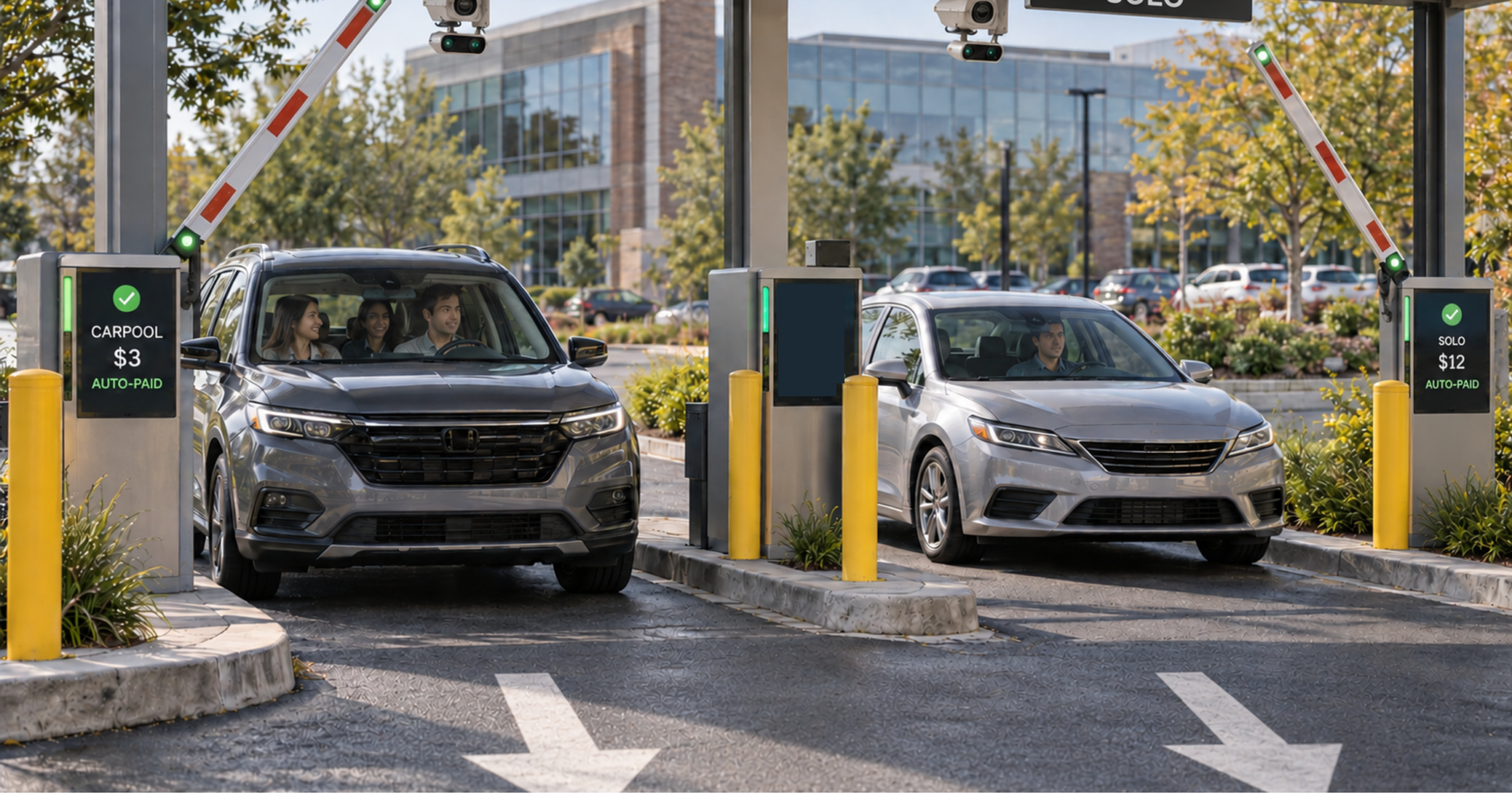
- Zone-based pricing directs cost-sensitive commuters toward lower-demand areas. It redistributes occupancy without introducing inflexible mandates.
- Demand-responsive rates adjust to real-time or projected occupancy. On high-demand days, you can increase parking costs to shift rate-sensitive commuters to alternative transportation. This frees capacity without adding a single physical parking spot.
- Cash-out programs pay employees to give up parking access on days they don’t need it. They convert unused parking inventory into a powerful financial incentive for changing modes.
All four principles work together to create a pricing environment where parking costs reflect actual supply-and-demand dynamics. Economics 101, with a massive organizational benefit.
Parking policy as a sustainability tool
By siloing sustainability programs and parking policies, you create a structural ceiling that doesn’t need to be there. That ceiling disappears when both concepts are integrated and purpose-built to complement each other.
For example, consider a daily parking reservation. We just established that daily, dynamically priced permitting systems send powerful behavioral signals. Yet, they also generate verified attendance data that connects directly to Scope 3 emissions reporting.
In other words, every parking reservation becomes a documented commute event tied to a specific employee, date, and transportation mode. Annual commuter surveys cannot produce data anywhere near that quality — and emerging compliance frameworks are increasingly setting the data quality bar higher and higher.
You can extend that thinking to concepts like capacity caps and zone management to shape the modal environment with even greater effect. Reserving a portion of daily inventory for high-occupancy vehicles (HOVs) and electric vehicles (EVs) makes sustainability more attractive than driving solo, without mandating anything. It’s even more effective when paired with visible, enforced priority.
When paired with transit subsidies and strong support for active commuting, parking cash-out programs can have a similar impact. Studies have documented demand reductions of up to 39% in well-designed cash-out programs. That’s a very meaningful Scope 3 reduction with a verifiable data trail attached.
The key principle: Parking policy doesn’t just reflect sustainability goals. When designed correctly, it actively advances them.
CommuteHub helps organizations integrate parking access, cost control, and sustainability
Integration creates the functional synergy between access, cost, and sustainability that takes parking management success to the next level. When reservation systems, pricing rules, HR data, occupancy analytics, and TDM programs share a common data environment, every element informs all others:
- Occupancy data triggers pricing changes
- Pricing levels shape demand
- Parking demand shapes commuter behavior
- Commuter behavior generates compliance and reporting data
You can enjoy all of this without building a single extra parking spot. All you need is a proactive, coordinated approach to parking management and the right tech tools to guide you along.
CommuteHub delivers those exact tools. This powerful platform seamlessly manages daily reservations, dynamic pricing, wage-based access tiers, cash-out administration, HOV and EV zone management, occupancy analytics, and more — all in one place. It’s backed by Commute AI and agentic decision-making support to help you surface the right information, right when you need it.
Talk to a CommuteHub expert to arrange a personalized demo today.