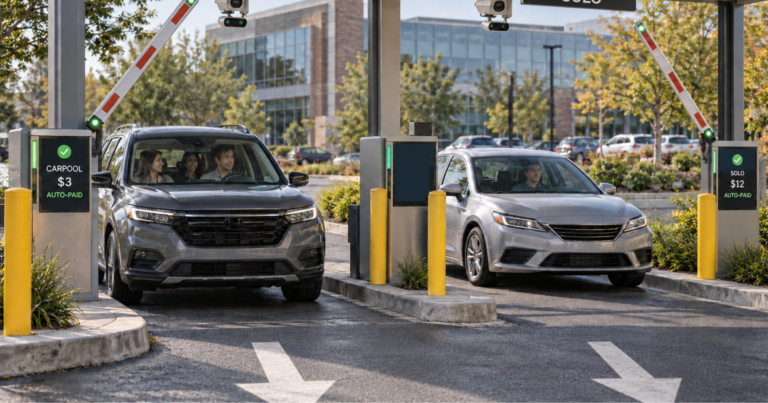

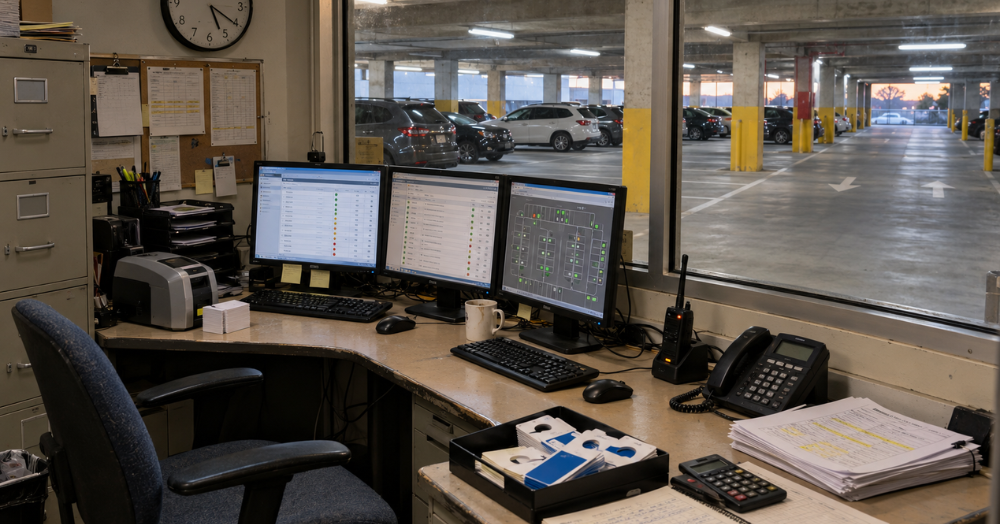
Every organization that runs manual parking operations carries a hidden administrative burden. That burden doesn’t show up in budgetary line items or financial statements. Instead, it steadily accumulates in extra working hours and operational friction.
Intelligent parking management systems eliminate that cost burden by replacing reactive, labor-intensive workflows with automated, data-driven operations. The result: a leaner, more efficient commuter and parking program that delivers a superior experience to everyone it serves.
These hidden administrative costs tend to cluster around four specific areas:
- The daily capacity management burden
- The on-site customer service cost nobody budgets for
- The multi-system administration penalty
- The administrative price of data-blind enforcement
Every one of these unnecessary costs is fixable. Here’s how intelligent parking management systems eliminate them.
The daily capacity management burden
For program administrations with manual operations, capacity management is a daily issue. Every morning brings a fresh set of questions:
- How many permit holders will actually show up?
- Will a planned event trigger a demand spike in a specific lot or facility?
- Did yesterday’s no-show permit holders free up spaces that could have been offered to someone else?
Managing these variables without automation means using physical signage, adjusting systems manually, and scrambling to react when unfolding events don’t match expectations. These efforts carry real — and significant — administrative costs.
Those costs are easy to overlook because they’re diffuse. Instead of arriving as a tangible line item, they filter through your team in constant increments, climbing with each passing day and growing at the same scale as your parking operations.
At its root, the problem is structural. Manual capacity management is reactive by nature. As a result, friction has already happened by the time your team is able to implement a solution.
Automated daily parking reservations change the equation entirely. Instead of holding extra parking inventory in reserve for permit holders who may not show up, you can right-size your supply to actual, verified demand. From there, administrative benefits naturally follow:
- With fewer spaces held in reserve, you’ll have more inventory available for flexible, on-demand access.
- Predictable daily demand data makes it quick, easy, and accurate to set capacity thresholds, special-event holds, and surge pricing rules.
- Automated policy enforcement enables your team to handle routine adjustments without manual intervention, freeing up administrators for higher-value work.
The shift from reactive to proactive capacity oversight is where intelligent parking management systems excel at delivering administrative relief.
The on-site customer service cost nobody budgets for
When a manually managed parking lot unexpectedly fills up, someone has to deal with the fallout. That can mean:
- Personally redirecting arriving commuters and visitors to alternate parking facilities
- Fielding complaints from users who had valid permits but couldn’t park
- Resolving conflicts about payments, access rights, and enforcement decisions
All of this will happen in real time, with your staff members on the clock.
These types of costs are rarely (if ever) included in a parking program’s budget. Yet, there they are, scaling alongside demand. Every high-occupancy day has the potential to spiral into another wave of on-site service burdens that fall on staff who are already dealing with other pressing matters.
The most frustrating aspect? These costs are almost entirely avoidable. They mainly exist because commuters and visitors arrive on site without any reliable information about parking availability.
When people don’t know where to park prior to arrival, they usually just show up anyway and hope it all works out. If that happens at scale, on-site interventions become inevitable.
Intelligent parking management systems address this issue at its root cause, giving commuters the information they need before they ever leave home. This information can include:
- Real-time availability data
- Advance reservation tools
- Automated notifications about changing conditions
These interventions help you avoid other, harder-to-quantify costs. Commuters who regularly encounter parking friction carry those negative experiences with them into the workplace. This can lead to job dissatisfaction, reduced productivity, and higher turnover rates. That’s a big part of the reason employers increasingly view the commute as an essential element of their workforce management strategy.
The multi-system administration penalty
Manual parking management usually happens across a patchwork of disconnected systems. Permitting happens in one platform, access controls in another, enforcement in a third, and payment processing somewhere else entirely.
As each system functions in siloed isolation, layered administration costs accumulate:
- Duplicated data entry increases error risk in every system that touches a parking record
- Multiple software licenses and IT maintenance contracts bloat your overhead costs
- Synchronization failures create policy gaps and extra work for the staff members who have to reconcile them
The synchronization element merits particular attention. When systems fall out of sync, consequences add up fast. Permitting data and access control data start contradicting each other. Enforcement standards become less transparent, and commuter disputes pile up.
A unified parking management system removes these failure points by creating a single, authoritative, and verifiable source of objectivity across every function of your parking operation.
The administrative price of data-blind enforcement
Manual enforcement is also expensive, and in ways that aren’t always easy to see. Enforcement can only be as reliable as the data that informs it. When permit records, access information, and payment data live in separate systems, operational silos become gaps in your enforcement capability and excess administration follows.
Enforcement inconsistencies also set deeper administrative costs in motion. If commuters figure out that nobody notices violations, permit compliance and system trust begin to erode. People test boundaries, violations multiply, and internal conflicts arise. Your staff then has to spend more time mediating disputes, processing appeals, and chasing after payments.
Intelligent parking management systems help break this cycle by grounding enforcement in integrated data collected from:
- License plate recognition (LPR) systems
- Real-time, cross-referenced permit and access validations
- Automatic violation tracking
These features combine to generate auditable records that reduce conflict and lighten administrative loads. The end result is fewer issues to deal with and faster resolution times for those that do occur.
CommuteHub eliminates the hidden costs of manual parking management systems
The extra administrative costs that arise from manual parking management are real — and they’re also entirely avoidable. CommuteHub can help your organization replace friction, inefficiency, and redundancy with ease, automation, and seamless integration.
CommuteHub’s suite of built-in features includes:
- Automated capacity management and daily reservation tools that eliminate manual effort
- Real-time availability data that eliminates the need for physical, on-site customer service
- Integrations that make siloed operations, multi-system redundancies, and syncing failures a thing of the past
- Data-driven enforcement tools to reduce violations, disputes, and the overhead costs of issue resolution