

A parking reservation is essentially a simple but important promise: When you arrive, your space will be available. This certainty plays a powerful role in shaping commuter behavior. When people trust the parking system, they engage more readily with commuter programs and make smarter, more sustainable choices.
Yet, parking reservations are only as reliable as the administrative infrastructure behind them. Without enforcement, a reservation amounts to little more than a suggestion. This exposes your entire permitting system to risks that can undermine confidence in your parking program.
Parking control systems offer a transparent solution that generates real value for organizations. By connecting reservations directly with policy enforcement, you transform a simple logistical promise into a predictable and dependable reality for every commuter in your organization.
Here’s how reservations and enforcement fit together.
Commuters want certainty from parking reservations
A parking spot isn’t the most valuable thing a reservation delivers. Certainty is. This matters because a person who knows their spot is reliably secured will make different decisions than a person who doesn’t. Instead of rushing out the door to arrive on time to claim an empty space, they arrive relaxed. Instead of keeping a reservation they don’t need, they release it to free up a space for someone else to use.
This principle applies to multiple user types. Holders of guaranteed permits and daily choice parking users have different profiles, but they both benefit from the same upstream confidence that comes from knowing the system is working as advertised before they even start their journey.
When that confidence filters through your entire organization at scale, incredible things can happen. Commuter program participation rates improve. Modeshift and sustainability goals become more achievable. Parking friction wanes, and commute-related stress dissolves.
Trust forms the basis of your parking program’s entire foundation. That trust arises from one deceptively simple principle: knowing the rules actually work.
Parking control systems can accommodate both reserved and unreserved demand
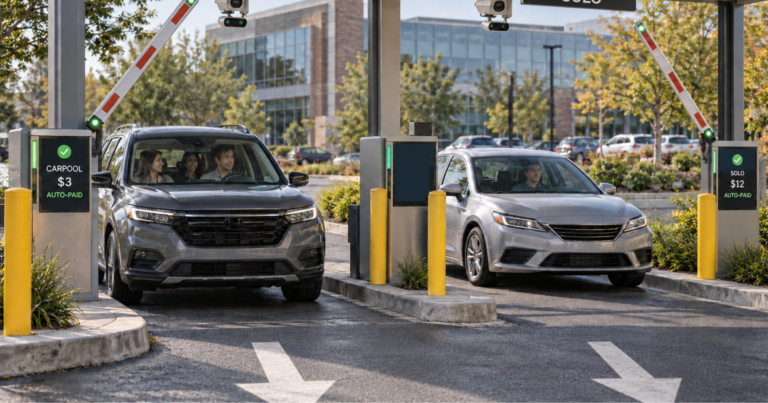
Not every parking spot needs to be reserved ahead of time. Smart parking control systems manage both reserved and unreserved inventory simultaneously, an operational benefit that protects committed spaces while routing available capacity to arriving users on a walk-up basis.
It’s similar to the way airlines manage their seating capacity. Most seats are sold in advance, but some are held back and released to a pool of potential buyers as departure day approaches. Parking hardware controls who enters your facility, just as airport gates control who boards a plane. No seat on a plane goes to waste, and you can configure parking software to achieve the same outcome for your unused inventory.
This is relevant because parking management models increasingly depend on precisely this kind of operational layering. As researchers from Texas A&M’s Transportation Institute note, hybrid working arrangements have upended traditional parking demand models, and tiered coordination has become critical to optimizing efficiency.
A reliable reservation system is what makes the entire equation add up. It doesn’t restrict access, but rather organizes it. As a result, every user — with or without a preexisting reservation — has a clear and predictable path to available parking.
Enforcement is an extension of your parking infrastructure
Reservations create the promise between your organization and its parking facility users. Enforcement is what makes that promise credible and trustworthy. Without it, every other aspect of your parking program becomes exposed to the risks that arise when your users don’t follow the rules you’ve set.
These risks include:
- Unauthorized vehicles taking up reserved spaces
- Cross-facility occupancy rates becoming uneven as demand concentrates in preferred locations
- Escalating administrative burdens
- Erosion of commuter trust
Parking control systems alleviate these risks through two main mechanisms:
Controls at gated facilities
Gated facilities physically prevent unauthorized entry and facility use. Approved users gain access by tapping a badge or electronic card, or through license plate recognition (LPR) systems. Unreserved capacity then flows through to walk-up users on a first-come, first-served basis.
Controls at ungated facilities
In ungated facilities, LPRs play a critical role in preventing misuse. Automated enforcement tools validate vehicles against a live authorization database in real time, flagging unauthorized entries and deploying human resources only when necessary for security purposes.
Remember: Enforcement doesn’t have to be punitive. Instead, think of it as a structural layer of your parking operations that makes everything else in the system work.
Designing a graduated enforcement system that starts gently and escalates deliberately
For workplace parking enforcement to work effectively, it can’t start with penalties. Instead, it should lead with light touches and escalate only when a clear pattern of bad-faith behavior emerges.
This approach matters for two reasons. First, it preserves the commuter relationship, keeping it grounded in mutual respect. Second, it reduces administrative costs because it automates responses that you would otherwise need to issue manually.
To build a graduated enforcement system, create interventions along a ladder that starts at “friendly” and escalates to “consequential.” At the low end, these could include push notifications or email reminders that a user has parked in the wrong place or overstayed their time at an EV charger. At the high end, it could climb to fines, penalties, or loss of parking privileges.
The principle is simple: meet users with fairness first, and use parking control systems to escalate enforcement intensity only in situations that truly warrant it.
The operational and user experience payoff
When reservations and enforcement work in tandem, the benefits become concrete, tangible, and measurable for both administrators and commuters.
Administrators gain operational clarity:
- Violations emerge organically through data, rather than from user complaints
- Permit and waitlist management resolve automatically, without additional effort or labor
- Policy is applied with perfect consistency across all facilities, zones, and permit types
Commuters win because the system visibly works:
- Reserved spaces are available as promised
- Rules apply to everyone equally
- Everything is tracked, so there are no surprises or disputes
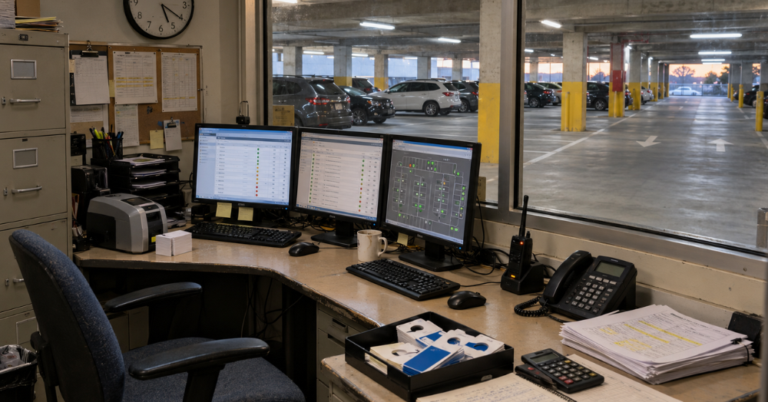
Parking control systems also catalog enforcement data, making it available for strategic analysis. Occupancy patterns, violation events and trends, and peak demand windows all become visible. Transportation managers gain the insights they need to refine policies and anticipate demand proactively.
This all leads to a parking program that doesn’t just manage access, but actively shapes how and when people choose to commute.
CommuteHub connects parking control systems at every level
Reservations and enforcements aren’t separate. They’re two sides of the same operational coin. When you connect them with a single, unified parking management platform, you can build the kind of fair, transparent, and reliable system that engages users and builds trust.
CommuteHub facilitates this with parking management tools that connect every layer of your parking system, from permitting to enforcement. With CommuteHub, you can create a parking program that earns and keeps the trust you need to make your broader commuter management efforts a success.