

Hybrid work was supposed to make parking easier. Fewer people in the office meant fewer cars in the lot, less pressure on facilities, and more breathing room for overextended parking programs.
That’s not what happened. Instead, hybrid schedules concentrated demand into fewer days, creating a new and stickier problem. Demand became harder to predict, harder to distribute across facilities, and far more prone to commuter friction.
For organizations looking for efficient, cost-effective, and commuter-friendly solutions, parking lot management software has become an indispensable tool. To make the most of it, you need to understand how it interacts with four key parking management concepts:
- Why hybrid work created a harder parking problem
- Dynamic parking allocation and how it works
- Managing peak demand without overbuilding supply
- Utilization data and how it informs decision-making
Let’s break it down, piece by piece.
Why hybrid work created a harder parking problem
In its 2025 Mobility Report, the Texas A&M Transportation Institute documented what many organizational transportation managers already knew from experience: Hybrid work didn’t flatten parking demand. It redistributed it.
Tuesday and Wednesday volumes are now significantly higher than their pre-pandemic peaks. Friday volumes have dropped substantially. The demand curve now tends to spike during the midweek period while collapsing at the edges.
Static parking systems don’t respond to these changes. They were built for Monday-to-Friday averages — a commuting landscape that no longer exists with the same stable predictability it once had.
Many organizations that still use pre-pandemic demand modeling strategies are now facing new problems: On peak days, parking facilities are overcrowded, but on light days, they’re sitting half-empty. Meanwhile, demand fluctuates wildly from day to day and week to week, creating headaches for administrators and parking friction for commuters.
The default response would be to add capacity capable of absorbing peak demand. In practice, that can easily lead to a costly misstep. Building parking infrastructure to match peak demand leaves organizations prone to chronic underutilization. That represents a huge investment that won’t generate nearly enough of a return.
Instead, reframe the issue. The problem isn’t a lack of capacity. It’s inefficiency rooted in misaligned demand distribution — and that’s something parking lot management software can help you solve by allocating parking dynamically.
Dynamic parking allocation and how it works
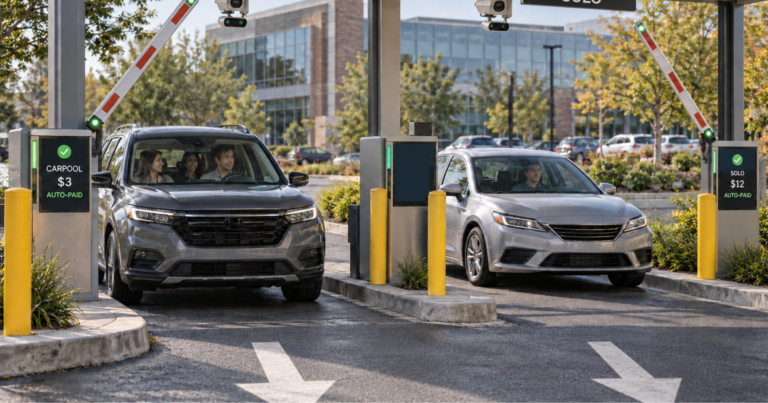
With dynamic allocation, you’ll use both predictive and real-time signals to assign access to facility users. Instead of fixed monthly or annual passes, you can use a daily choice system that uses parking lot management software to connect your program across three touchpoints:
- Human resources and scheduling integration. Parking management software can connect directly to workforce scheduling systems. It knows who is confirmed on site before people arrive, then it automatically adjusts parking supply to match demand. Employees working remotely won’t hold inventory that could serve someone else.
- Rules-based permit logic. Specific employee populations — full-time staff, contractors, visitors, and so on — get set up with different access rules, eligibility guidelines, and pricing tiers. The software’s rules engine evaluates those criteria dynamically against live scheduling data. The result: Everyone gets the access they need, with no manual review required.
- Reservation-based access. Daily parking reservations give administrators demand visibility that static permit systems cannot provide. You’ll see Tuesday’s demand building on Monday afternoon, and you’ll have time to respond before any problems materialize.
By using parking lot management software to connect these three touchpoints, you can eliminate the problem of phantom demand — the phenomenon of unused permits consuming capacity on low-attendance days.
When you eliminate phantom demand, parking supply unlocks. You can then monetize that supply while simultaneously building a better experience for your commuter base.
Managing peak demand without overbuilding supply
Peak demand days are usually predictable. They occur in tandem with all-hands meetings, end-of-quarter crunches, major campus events, and the like. Peak days also expose all the weaknesses of static parking management systems.
If peak demand is an edge case rather than a common occurrence, it doesn’t make sense to plan your permanent infrastructure capacity around it. Instead, you can use parking lot management software to respond intelligently to actual on-the-ground conditions.
The process starts with demand identification. When scheduling and reservation data flag a high-demand day in advance, the system can trigger automated responses:
- Opening overflow zones
- Capping reservations
- Adjusting pricing
- Promoting alternative travel modes
Dynamic pricing is an especially powerful parking strategy. When parking carries a visible, demand-responsive cost, price-sensitive commuters self-select other transportation modes. You don’t have to mandate anything. Instead, you just let normal economic dynamics do their thing.
Peak days also offer a great opportunity to promote your mode-shift programs. When scarcity signals impact parking pricing or availability, your commuters become far more likely to seek out smarter alternatives. Some of those commuters may enjoy the change and stick with it.
Utilization data and how it informs decision-making
Static permitting systems offer very little inward visibility. You’ll know who holds a permit, but not who actually used their permit on any given day. This lack of visibility also extends to parking zone utilization patterns, daily and seasonal demand fluctuations, and many other metrics capable of generating game-changing insights.
Those data gaps have consequences: Anecdotes, intuition, and complaints dominate capacity decisions. Infrastructure gets overbuilt. Underperforming zones never get reallocated or repriced because nobody actually has the data in hand to show they’re underperforming in the first place.
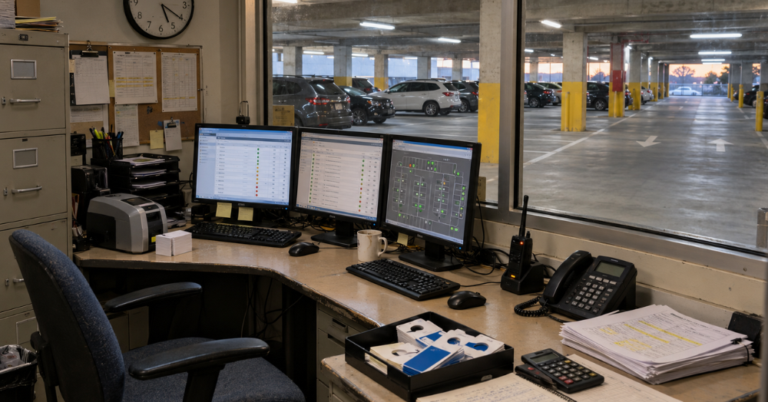
Parking lot management software bridges data gaps. Instead of relying on manual counts or labor-intensive gate log analyses, administrators can access authenticated data in real time. That data covers utilization metrics like:
- Real-time occupancy rates, segmented by zone
- Daily and weekly utilization trends
- Demand forecasting based on historical patterns
Software platforms also generate proactive intelligence by flagging underutilized inventory, highlighting anomalies, and delivering actionable recommendations based on data-driven insights. You’ll suddenly be aware that a peripheral lot is running 40% below capacity every Monday and Friday, or that your EV charging spots aren’t turning over fast enough.
That intelligence transforms parking from a reactive problem into a proactive transportation demand management tool. When administrators can see exactly how demand moves across days, zones, and employee populations, data stops describing a problem and starts becoming the source of the solution. That leads to better commute experiences, smarter resource use, and meaningful progress toward sustainability targets.
CommuteHub parking lot management software powers smarter hybrid commuting
When scheduling data, permit rules, reservation systems, dynamic pricing, and utilization analytics work together in a dedicated software platform, you get a powerful parking management system that replaces laborious manual inputs with easy automation. This is precisely what CommuteHub delivers.
CommuteHub makes it a breeze to encode complex eligibility logic directly into your parking management system. You can automatically handle approvals, renewals, and access rights for every employee classification, across any number of parking facilities.
HR integrations connect workforce scheduling data to parking inventory in real time, so dynamic allocation runs on confirmed attendance rather than assumptions. Intelligent reservations give administrators advance demand visibility while providing commuters with guaranteed access when they need it. From there, dynamic pricing and capacity management tools let organizations respond to peak days proactively.
All the while, CommuteHub’s agentic reporting and analytics tools surface insights that connect both sides of the user-administrator parking equation. These features power the game-changing shift from reactive problem-solving to proactive demand management.