

Parking sounds simple until you actually have to manage it.
You have a limited number of spaces. People want to park at different times. Some need parking every day, others only once a week. Some spaces are reserved, some are paid, and some might suddenly become unavailable because of construction, an event, or maintenance.
And then there is everything that happens around the parking space itself: permits, reservations, payments, access control, license plates, cancellations, and the inevitable “I was charged for parking, but I couldn’t park” message.
The good news is that you don’t necessarily need more parking spaces to make parking work better. Often, you need a better way to manage the spaces you already have.
This guide covers some of the most practical ways organizations can manage parking demand, from daily permits and reservations to capacity management, payments, and license plate recognition.
Parking management at a glance
Before getting into the details, here are some of the most common parking management options:
- Parking permit: Gives a person permission to park in a specific facility or area, usually on a recurring basis.
- Daily or hourly parking permit: Gives someone parking access for a specific day or short-term time block rather than on an ongoing basis. This is ideal for hybrid workplaces or visitors where parking demand fluctuates throughout the day.
- Parking reservation: Lets someone reserve available parking for a specific date or time. A reservation is about availability, while a permit is about permission to park.
- Capacity management: Controls how many parking spaces are available for booking or purchase, including temporary changes when capacity is reduced or increased.
- License plate recognition (LPR): Uses a vehicle’s license plate to identify vehicles at a parking entrance or exit and connect physical access with a digital parking system.
Start with how people actually use your parking
Before choosing a parking system, look at the way people use your spaces today.
Do the same people park every day? Do most employees work from home several days a week? Do you have visitors who only need parking occasionally? Does parking demand change depending on the day of the week?
These questions matter because a parking space doesn’t necessarily need to be assigned to one person permanently.
For a hybrid workplace, for example, giving every employee a permanent parking permit might sound straightforward. But if half of those employees work from home on any given day, some of those spaces could sit empty while someone else is looking for somewhere to park.
This is where different parking models can make sense.
Daily parking permits can be a simple solution to hybrid parking
If your organization has limited parking and employees don’t come to the office every day, daily parking can be worth considering.
For example, imagine a workplace with 100 parking spaces and 200 employees. If most employees work from home two or three days a week, you may not need to give 100 people permanent parking rights.
You could instead release a certain number of daily parking spaces each day.
That creates a more flexible system, but it also raises some practical questions:
- How many spaces should be available each day?
- How far in advance can people book?
- Should some employees get priority?
- What happens when all spaces are booked?
- Can someone cancel and make the space available again?
- What happens when fewer spaces are available because of an event or construction?
A good parking program answers these questions before people start trying to use it.
With CommuteHub, organizations can create different parking products and permits, including paid or free options, and define how and when they are available.
How to Manage Parking Demand Spikes
Your parking lot might officially have 200 spaces. That doesn’t necessarily mean you should make 200 spaces available for booking every day.
Maybe 20 spaces are reserved for visitors.
Maybe part of the garage is closed for maintenance.
Maybe there is an event at your campus and you need to change your parking arrangements.
This is why parking capacity should be treated as something you manage, rather than a fixed number.
For example, if a garage normally has 100 available spaces but 15 are temporarily unavailable, you could reduce the available capacity to 85 for that period.
In CommuteHub, Capacity Overrides let admins temporarily change available parking capacity without changing the underlying parking setup.
Once the override ends, the normal capacity can apply again.
Additionally reserved parking eliminates the need to cruise for spots, noticeably easing traffic congestion.
A parking reservation is only useful if the experience continues when someone arrives
Booking a space is useless if you can’t actually get in when you arrive. When permits, bookings, payments, and gate access are scattered across different systems, the experience breaks down at the gate.
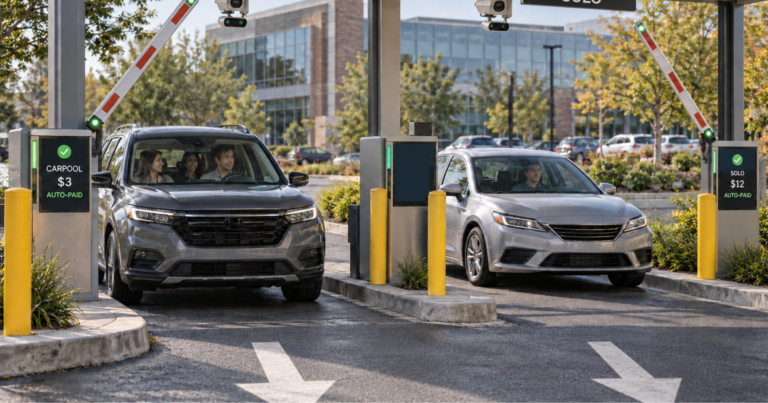
CommuteHub solves this by handling the entire journey in one application. Employees apply for permits, book spaces, find carpool buddies, and drive straight through LPR-integrated gates with automatic payments. If a charge needs reviewing, they can file an appeal directly in the app. Plus, they earn rewards points along the way.
That means parking management isn’t just about selling or reserving spaces. It’s also about making sure the person who booked the space can actually use it.
Paid parking doesn’t have to mean complicated parking
Organizations use different approaches to parking costs. Some offer parking for free. Others charge users the full cost. Some subsidize parking or use different prices for different parking options.
If parking is paid, having the payment process in the same experience as the reservation can make things considerably simpler.
In CommuteHub, users can purchase available parking products, while admins can manage bookings, purchases, cancellations, and refunds from the Management Dashboard.
There is also another interesting option for organizations that encourage carpooling: splitting parking costs between drivers and riders.
For example, a $10 parking charge could be split so that the driver pays 40% and the rider the remaining 60%.
That turns parking into something that can work alongside a broader commute program rather than being treated as a completely separate system.
Don’t forget about everything that happens when parking goes wrong
Every parking manager knows that the booking itself is usually the easy part.
The interesting situations start afterwards.
Someone booked the wrong day.
A parking facility unexpectedly closed.
A user was charged even though they couldn’t park.
A reservation needs to be cancelled.
A person believes a charge wasn’t correct.
You need a process for these situations.
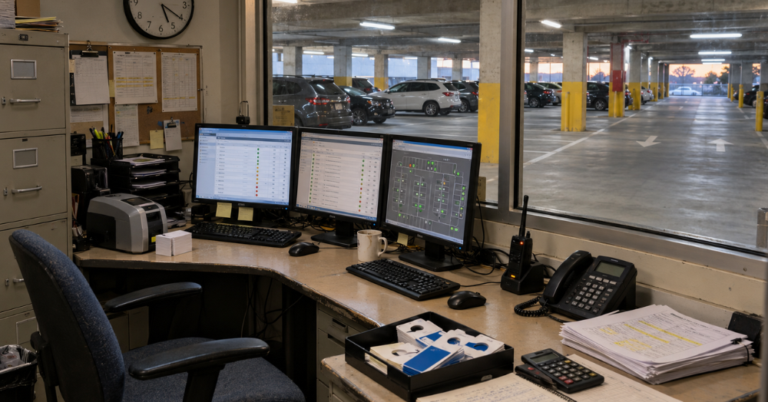
A useful parking system should make it possible for admins to review purchases and bookings, cancel reservations, issue refunds, and handle parking appeals without having to rebuild the entire parking program every time something goes wrong.
In CommuteHub, admins can manage these situations from the Management Dashboard, including reviewing purchases, cancelling bookings, issuing refunds, and reviewing parking appeals.
The goal isn’t to eliminate every exception. That’s probably impossible.
It’s to make exceptions manageable.
Use your parking data to find the spaces you already have
One of the most overlooked parts of parking management is what happens after the system has been running for a while.
You now have data.
Which facilities fill up first? Which days are busiest? Are some parking products rarely used? Are certain spaces sitting empty while another facility regularly reaches capacity?
These questions can help you decide whether you actually need more parking or simply need to manage your existing capacity differently.
For example, imagine you manage two parking facilities:
- Garage A regularly reaches capacity by 9:00 AM.
- Garage B still has plenty of spaces available.
The obvious conclusion might be that you need more spaces.
But there may be another solution: change which users can access each facility, adjust pricing, change capacity, introduce different parking products, or make the less-used facility easier to find.
There isn’t one perfect parking model
The best parking setup is usually not a single rule applied to everyone.
A hybrid workplace might combine daily parking reservations, capacity limits, and LPR access.
Meanwhile, universities might need different permits for students, staff, and visitors. And dynamic parking capacity management for events or visitors.
Hospitals might need recurring permits for some employees and flexible parking for shift workers. Our customers, such as OHSU, can customize their setup however they like.
And a multi-site organization might need different parking products and capacities for different facilities.
The important thing is to build the parking program around the way people actually use your spaces.
CommuteHub unifies your parking operations into one intuitive platform. By bringing together capacity tracking, reservations, permits, payments, and access integrations, organizations can seamlessly absorb demand spikes and optimize overall parking management.