

You might look at your organization’s excess parking inventory and see a sunk cost. Instead, view it as an opportunity. Parking reservation software can help you turn that extra inventory into a valuable source of extra revenue.
To achieve this outcome, you need to pair a deliberate pricing strategy with automated parking management tools. These strategic pillars can guide your thinking:
- Audit your parking utilization before pricing anything
- Build tiered pricing architecture that reflects actual demand signals
- Use dynamic pricing to monetize demand spikes without additional effort
- Align pricing incentives to match your sustainability goals
- Automate waitlists and reallocation practices to keep surplus inventory moving
Let’s look at how these concepts can help you turn idle parking spots into a positive return on your parking software investment.
Audit your parking utilization before pricing anything
The reality is that pricing decisions based on occupancy assumptions are almost always wrong. Facilities that seem full often have significant vacancy in peripheral areas, and lots that usually seem empty can sometimes spike to capacity. So, you need to start by establishing a reliable, data-driven baseline that accurately reflects actual utilization patterns.
Parking reservation software can help you do this by:
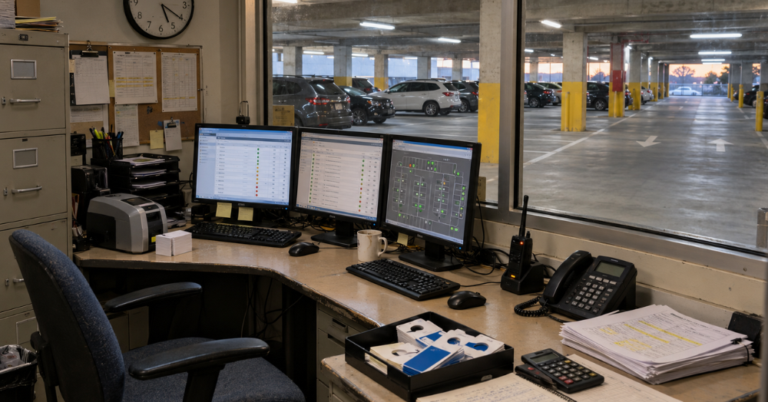
- Tracking and documenting parking trends over defined periods of time
- Segmenting demand by facility, zone, day of the week, or time of day
- Pinpointing how hybrid work schedules impact parking demand
With that data in your hands, you have a much clearer forward path. If inventory is genuinely scarce, you can build the case for premium pricing. Similarly, you can use consistent inventory surpluses to attract additional demand. You can then offer this inventory as flexible daily choice parking, or reserve it for dynamic allocation.
Whatever path you choose, this strategic foundation is an essential starting point. Without it, you’re just guessing.
Build tiered pricing architecture that reflects actual demand signals
Flat-rate pricing is a blunt instrument. It leaves money on the table for your best and most desirable inventory, and it also fails to shift demand toward underutilized spaces.
Tiered pricing solves both problems simultaneously, since it empowers you to set your pricing to reflect what users value most:
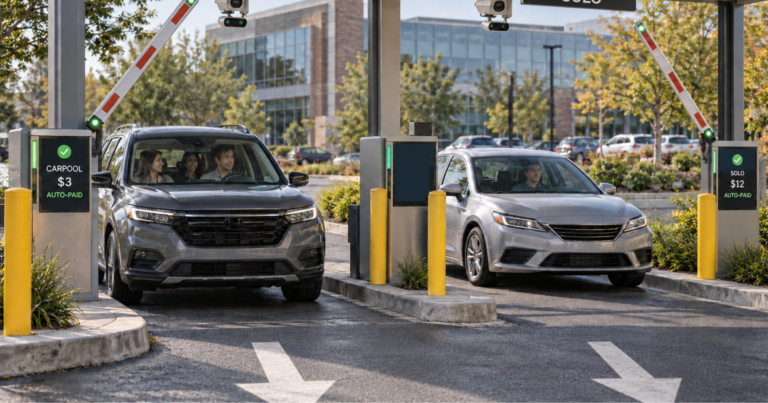
- If you’ve got extra spots in convenient areas, you can price them at a premium.
- Standard rates for general inventory can serve the majority of your users at modest rates.
- Discounted access to spots in peripheral locations will attract cost-conscious commuters and visitors.
You can also use parking reservation software to layer in time-based pricing. If spots remain available after a defined point in time, you can drop prices to advantageous walk-up rates. This can help you consistently convert available spaces into occupied inventory.
When done well, tiered pricing optimizes revenues while also distributing occupancy more evenly among facilities or locations. This helps reduce congestion and improve the commuter experience while making every tier of your parking program work harder.
Use dynamic pricing to monetize demand spikes without additional effort
Major campus events, all-hands-on-deck days, and end-of-quarter crunches all lead to predictable surges in demand. These are the times when static pricing strategies end up leaving the most money on the table: Your most desirable inventory disappears at standard rates before you have a chance to optimize its monetization at premium rates.
Dynamic pricing, powered by parking reservation software, removes human intervention from the equation. Rules-based pricing configurations completely eliminate manual effort by automatically adjusting rates in response to real-time occupancy signals. When demand rises or falls, your parking rates follow in lockstep without anyone needing to lift a finger.
The benefits of dynamic pricing also extend beyond revenue optimization. When prices climb during periods of peak demand, price-sensitive commuters self-select alternative transportation modes or head for less congested facilities where costs are lower. This creates a built-in transportation demand management win — one that organically shifts users to more sustainable modes while also reducing localized congestion.
Align pricing incentives to match your sustainability goals
Monetizing your surplus parking inventory does more than pad your revenues. It can also function as a policy tool and a powerful lever for prompting behavior change in your user base by encouraging more sustainable commuting habits.
The mechanics of this approach are straightforward: Offer discounted or complimentary reservations to commuters who use high-occupancy vehicles (HOVs). This creates a built-in financial incentive for users who consolidate trips.
You can also launch a parking cash-out program to commuters who volunteer to give up their parking privileges. In exchange, you can offer a flat-rate payout or — if you really want to entice participation — a direct share of the parking revenues their former spot generates.
As a supplementary strategy, you can then reserve your lowest-price daily access inventory for commuters who display a commitment to using sustainable commuting alternatives.
Each of these concepts performs double duty by nudging commuters toward smarter transportation alternatives while monetizing your surplus parking inventory. By connecting pricing logic to commuter behavior, your extra parking capacity becomes an active element of your transportation demand management program.
Automate waitlists and reallocation practices to keep surplus inventory moving
When reserved parking capacity goes unclaimed, it could reflect a pricing failure as much as a utilization failure. If a commuter pays for a spot but doesn’t use it, or has an assigned spot that goes unclaimed, you lose revenue while frustrating people who are on your parking waitlist.
The automation features of parking reservation software seal off these gaps. You can configure your parking management platform to automatically release unclaimed permits back into a general pool over a defined time window. Then, you gain the flexibility to offer that recaptured inventory at a dynamic rate or redistribute it to a waitlisted commuter.
From there, you can pair the release of unclaimed permits with automatic notification features so commuters know immediately when inventory becomes available. They can then make modal decisions based on that information, while you have fewer parking spaces sitting empty when they could have been filled.
Use parking reservation software to turn idle inventory into extra revenue
CommuteHub was purpose-built to execute every one of these pricing strategies while also collecting utilization data, automating commuter program management, and connecting users with modal alternatives. From occupancy tracking and tiered permitting to rules-based dynamic pricing and automated waitlist management, CommuteHub connects every layer of your parking program.
Use CommuteHub to:
- Establish utilization baselines using real-time data and historical occupancy patterns
- Automate tiered and dynamic pricing across facilities, zones, and permit types
- Support your sustainability objectives through HOV incentives, parking cash-out programs, and organic modeshift signals
- Eliminate manual intervention and administration to free up your program managers for higher-value tasks