

For transportation teams, permitting is often the single most labor-intensive activity in the entire portfolio. Every eligibility decision, waitlist update, and renewal cycle demands individualized attention, creating an administrative burden that seems to grow without end. Parking reservation software was built to change that.
Traditional permitting systems weren’t designed with hybrid work, multi-site complexity, or policy sophistication in mind. When the system can’t evaluate complex eligibility criteria or respond dynamically to changing employee schedules, every exception becomes a hands-on administrative task. All that extra work compounds, until something has to give.
Let’s start by exploring what is, for many organizations, the most acute source of permitting-related pain.
The permitting bottleneck nobody talks about
Conversations about parking technology often jump straight to pricing, enforcement, and occupancy tracking. These are all important, but they overlook permitting. As most transportation administrators will tell you, permitting is often where the most time is lost. It’s also the operational area least associated with automation.
The bottleneck emerges when permitting rules that exist in policy documents don’t functionally translate to the systems they govern. Every eligibility decision, waitlist update, and renewal cycle requires manual administration. Those tasks accumulate faster than small teams can clear them, leading to failure modes that are all too familiar:
- Eligibility exceptions get handled case by case because the system can’t evaluate complex criteria.
- Waitlists are maintained in spreadsheets that quickly become all but impossible to audit.
- Permits automatically renew regardless of actual usage while waitlisted commuters go unserved.
- HOV and EV permits get handed out on the honor system, with no verification or enforcement mechanisms in place.
That gap between written policy and operational reality is where administrative burdens accumulate. It’s also the point where purpose-built parking reservation software delivers its most immediate value. When policy is built into the system, it enforces itself and administrators gain the freedom to focus on higher-value tasks.
Manual permitting logic doesn’t scale
These types of permitting bottlenecks share a common thread: as organizations grow, they get worse. When a permitting system strains under the weight of a single campus, you can easily imagine how unmanageable things will become when multiple worksites, employee classifications, and permit types come into play.
The scaling issue isn’t solely about volume. It’s also about logic. Manual permitting systems can handle simple and static eligibility criteria reasonably well. However, they break down when criteria become more variable, and when eligibility depends on a combination of factors like work locations, employee classifications, HOV status, or EV registration.
Parking reservation software solves this by encoding a permitting rules engine right into your system:
- Even the most complex eligibility evaluations run automatically, at any volume, without the need for manual staff involvement.
- Waitlist priority queues, hold periods, and vacancy notifications resolve with no manual input required.
- All permit types, from standard daily and monthly reservations to event-based special cases, are all governed with consistent rules-based architecture.
- Usage thresholds define renewal cycles instead of arbitrary calendar dates.
With automation, administrative relief adds up fast. Decisions that once required human judgment — and manual effort — happen instantly and consistently, regardless of organizational complexity. Programs that previously required entire management teams start running largely on their own. Time and cost savings rapidly accumulate, and paths to ROI on your parking software investment become clear.
Hybrid work killed the monthly permit model
Fixed monthly permits were built for a world where employees showed up five days a week on a predictable schedule. As Texas A&M researchers noted in their 2025 Urban Mobility Report, that world is gone.
For most office-based and hybrid-eligible employees, in-person attendance requirements now vary by week, role, and personal circumstances. Traditional monthly permitting models have no mechanism for handling that variability with anything approaching the required efficiency.
The administrative fallout is meaningful. Modification requests pile up as schedules shift. Exceptions multiply for employees whose on-site attendance patterns don’t fit fixed permit categories. Occupancy data becomes more unreliable because it reflects allocations rather than actual usage.
Flexible permitting architecture, powered by parking reservation software, replaces these systemic shortcomings with solutions:
- Daily choice permitting lets employees reserve on demand, within whatever parameters their eligibility defines.
- Scheduling synchronization uses HR integrations to tie access and permit availability to each employee’s confirmed on-site presence.
- Hybrid-friendly waitlists dynamically manage variable levels of daily parking demand, allowing administrators to rely on actual data instead of capacity guesswork.
The administrative payoff is immediate, and the occupancy data your automated system will generate is far richer.
Permitting as an underutilized TDM instrument
Most permitting systems are designed to answer only basic questions: Who is allowed to park? Where can they park, and for how long?
This approach makes for a good starting point, but it leaves significant strategic value untapped. More sophisticated permitting logic allows you to elevate your parking policy above simple access control and turn it into a delivery system for your transportation demand management (TDM) goals.
The opportunities are specific and practical. You can:
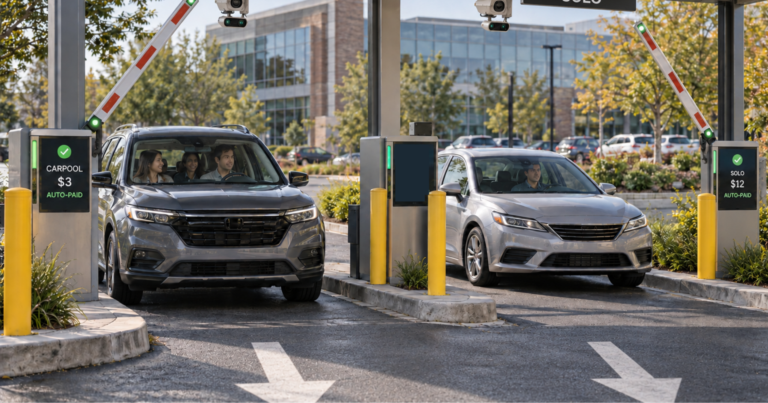
- Encode HOV eligibility verification directly into your permitting process. Carpoolers receive priority access automatically, without manual review or honor-system assumptions.
- Surface parking cash-out opt-ins during the permit renewal workflow and seize the moment commuters are most likely to consider alternatives to driving.
- Flag chronically underused permits and so you can offer affected commuters alternatives and make more efficient use of your parking capacity.
- Connect permit issuance and utilization data to Scope 3 reporting. This feeds your emissions cataloging system without any additional administrative effort.
These shifts have direct value: Manual permitting systems consume your administrative capacity, but automation liberates it. This frees your program managers to focus on more meaningful goals surrounding behavior change, mode shift, and sustainability outcomes.
CommuteHub automates permitting at every level
Purpose-built for the complexity that manual permitting systems can’t handle, CommuteHub encodes permitting logic directly into the platform. It eliminates, at scale, the eligibility reviews, waitlist updates, and renewal cycles that consume your administrative capacity.
Organizations that switch to CommuteHub report a 90% reduction in the time it takes to process permits, passes, and reimbursements. For teams managing permitting across multiple sites and employee populations, that’s a massive operational shift.
CommuteHub handles the full permitting lifecycle in one centralized platform that facilitates:
- Automated eligibility evaluation, even across complex rules systems
- Dynamic waitlist management with automatic notifications and vacancy reallocation
- Flexible daily choice permitting synced with HR and scheduling systems
- Utilization-based renewal cycles that keep parking inventory moving
- Built-in Scope 3 compliance reporting powered by verified data
For employers, this all adds up to less overhead, better data, and a parking program that works for everyone.