

The Association for the Advancement of Sustainability in Higher Education (AASHE) uses a framework known as the Sustainability Tracking, Assessment & Rating System (STARS) program to measure environmental performance relative to peers. Hundreds of colleges and universities around the world use STARS to measure, benchmark, and communicate their sustainability performance.
Transportation lives within the framework’s Operations category. It represents one of the most consequential credit areas an institution can pursue. It’s also one of the most contested.
The central challenge is structural. To earn Transportation credits, you’ve got to influence the daily behavior of tens of thousands of individual commuters — all of whom make independent decisions about how to get to campus on schedules you don’t set, using modes you don’t own or control.
Given these realities, the Commute Modal Split credit is one of the hardest to earn in the entire STARS program. It’s hard, but it’s attainable. Universities that combine smart parking and transportation services with a campus-wide transportation demand management (TDM) program have a significant and measurable advantage.
This guide explains everything you need to know to earn the Commute Modal Split credit:
- How the credit works in STARS 3.0
- Collecting data that meets the representative sample standard
- Strategies that move the needle on modal split
- Turning your TDM program into your STARS submission
- A staged approach for institutions at any starting point
It also explains how CommuteHub can help at every step of the way.
Understanding the Commute Modal Split credit in STARS 3.0
Transportation sits within the Operations section of STARS, alongside credits for initiatives like energy and water use, waste reduction, and greenhouse gas emissions. The primary commute-related credit is OP 14: Commute Modal Split. The OP 14 credit underwent a significant structural change in STARS 3.0, which was released in June 2024.
Under the previous version, STARS 2.2, Transportation included a separate programmatic credit known as Support for Sustainable Transportation. That program rewarded institutions for having things like bike infrastructure, transit subsidies, carpool matching, vanpool matching, and the like. Points were awarded solely for program availability, not outcomes.
STARS 3.0 shifted that logic. OP 14 is now scored on results, which primarily focus on the percentage of students and employees using “more sustainable” alternatives to single-occupancy vehicles (SOVs). Under STARS 3.0, you earn more points as the share of your campus community using sustainable alternatives rises.
STARS 3.0 also introduced bonus credits in the Innovation & Leadership category, including a Shared Mobility Program credit to recognize institutions that incentivize:
- Public transportation
- Bikeshares or shared e-scooters
- Carsharing, ridesharing, and carpooling
These optional credits offer additional scoring opportunities if you’ve already got a strong commuter program in place.
Key data requirements for OP 14
Under the STARS 3.0 framework, the data you collect and submit for OP 14 credit must meet the following requirements:
- The data you submit must be from within three years prior to your submission date. You can use either a single year, or an average across the entire reporting period.
- Each assessment must reach a representative sample. You cannot isolate a single class, department, or college and collect data only from that group.
- You must document and explain your data collection methodology, timeframe, modal coverage, and the representativeness of your sample.
- Full-time equivalent (FTE) figures must be consistent with those you report elsewhere in your STARS submission, such as in the PRE 3: Institutional Characteristics category.
How to collect data that meets the representative sample standard
To earn points in the OP 14 category, you must demonstrate that you have adequately assessed campus commuting behavior. The score you earn ultimately depends on the quality of your assessment.
Administrators have traditionally used annual campus-wide commuter surveys. However, this approach has several well-documented weaknesses:
- Response bias. Commuters who already use alternative modes are more likely to complete a commute survey than those who drive alone. This systematically inflates your sustainable mode share in ways that are difficult to correct without knowing who responded and who didn’t.
- Temporal distortion. Timing is everything when it comes to data accuracy and defensibility. A survey administered in October misses the winter driving spike. A survey sent on a Thursday misses the fact that Tuesday and Wednesday are consistently the highest-drive days on most campuses.
- Survey fatigue. Repeated surveys see diminishing returns. As response rates decline, the representative sample requirement becomes increasingly difficult to satisfy under the stricter scrutiny of STARS 3.0.
The solution? Continuous trip logging powered by a specialized commuter management platform. Logging addresses all three of these problems simultaneously by collecting verified data as a byproduct of daily commuter participation.
Whenever commuters use your parking reservation systems, transportation incentives platform, or transit pass, your TDM platform will automatically generate a representative record of actual commuting behavior. The data reflects real decisions made on real days, not recalled estimates made weeks later.
Strategies that move the needle on modal split
To actually move the needle on modal split, you need proven TDM strategies for prompting behavior change and cutting down SOV trips as part of a campus-wide commute trip reduction (CTR) effort.
In support of those goals, these strategies stand especially tall:
Daily parking reservations
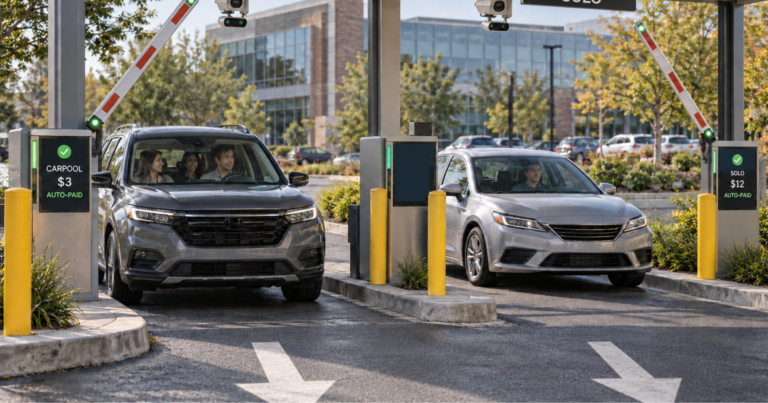
For a single structural change with an outsized impact, replace semesterly or annual parking permits with a system built around daily parking reservations.
Permits that are time-based and unlimited function in the commuter’s mind as a sunk cost. Once the permit is paid for, the cost of driving to campus on any given day drops to zero in the commuter’s mind.
Daily parking pricing dissolves that lock-in. When each commuting day carries a direct, visible cost, the modal decision reopens every morning. As one of the most thoroughly documented initiatives of its kind, Vanderbilt University’s highly successful MoveVU program has several valuable lessons to offer.
VU piloted their program in 2020, in collaboration with the Duke University Center for Advanced Hindsight. Their joint research found that framing the daily transportation decision around costs significantly improved adoption rates for sustainable alternatives.
Parking cash-out programs
Parking cash-out programs take the financial logic even further. Rather than simply charging for parking, cash-out programs pay commuters to give up their parking access. This directly converts unused parking benefits into a financial reward for commuters who choose alternative modes.
Research consistently shows that cash-out programs are highly effective. Some studies have shown reductions in parking demand of up to 45% in well-designed programs.
Personalized travel recommendations and trip planners
The single biggest barrier to mode shift on most campuses isn’t resistance. It’s that most commuters have never seriously evaluated the available alternatives from their specific home address because it’s easier just to drive.
A centralized commute options hub removes that friction. When a commuter can enter their address and immediately see relevant transit routes, estimated travel times, cost comparisons, and available incentives, their decision changes in a way that no general awareness campaign can replicate.
Behavior-based incentives
When it comes to habit formation, behavioral research has consistently demonstrated that small, frequent, and variable rewards outperform large but infrequent rewards. This principle is rooted in operant conditioning research, and has recurred in TDM-specific contexts through studies by the Massachusetts Institute of Technology, the Bay Area Rapid Transit (BART) system, and the University of Groningen, among others.
Points-based programs that reward every verified trip made with alternative transportation activate this exact psychological response. The element of variability — not knowing exactly what a redemption will yield — actually increases commuter engagement. Meanwhile, challenges and leaderboards add social proof and accountability, both of which are effective motivators.
Tiered status programs
Tiered status programs separate regular drivers from occasional drivers, giving occasional drivers access to higher status tiers. At these higher tiers, occasional drivers can unlock:
- Access to preferred locations
- Discounted parking rates
- Extra incentives, bonus points, or other benefits
Essentially, tiered status initiatives connect mode-shift incentives with parking benefits. For STARS, this makes every logged alternative trip a data point that works in your favor.
Support for active commuting
Biking and walking generate the highest sustainable mode-share value in STARS because they produce virtually no carbon emissions at all. For this reason, they’re directly named elements in the official OP 14: Commute Modal Split framework documentation.
Institutions need to provide endpoint infrastructure so commuter uptake of active alternatives doesn’t plateau. To this end, consider providing:
- Secure, controlled-access bike cages
- Shower facilities
- Clearly marked campus cycling routes
You can also connect your bike cage access system to each commuter’s trip logging account. That way, your cyclists will generate a verified data point for your STARS submission package every time they lock up their bike.
Commuter challenges, gamification, and mode-shift campaigns
Bike to Work Month, car-free challenges, and team-based competitions between academic colleges or departments help create temporary spikes in trial behavior. Some of that behavior change will stick, and the socially visible nature of gamified challenges and campaigns often reach commuters who wouldn’t normally self-enroll in a TDM program.
For STARS, these impacts go beyond engagement. They become verified modal data points in your TDM campaign.
To generate better results, time your gamified challenges around your fall and spring semester start dates. Commuting habits are usually the most malleable around these times, and you’ll likely get better results because of it.
Turning your TDM program into your STARS submission
Building a strong TDM program is half the battle. Translating program results into a defensible STARS submission is the other half. To do this, you’ll need to meet STARS 3.0’s OP 14 reporting requirements, which must specify:
- The percentage of students using more sustainable modes, with a full methodology description
- The percentage of employees using more sustainable modes, with a full methodology description
- The timeframe during which the assessment was conducted
- Which transportation modes were included in the assessment
- How you achieved a representative sample
Institutions often struggle with these requirements — not because they lack TDM programs, but because those programs run across disconnected systems. These disconnects become more pronounced in universities with auxiliary organizations, like affiliated hospitals or research parks, since auxiliaries may run their own totally separate, siloed programs.
This can lead to the exact issues that STARS reviewers often flag:
- Methodology inconsistencies
- Data gaps
- FTE mismatches
By running your TDM program on a single integrated platform, you can easily generate and export verified modal split data, program participation summaries, and methodology documentation. Your STARS submission essentially becomes a byproduct of your TDM program, not a separate annual project.
A staged approach for institutions at any starting point
STARS points are proportional. Moving your drive-alone share down even a few percentage points will capture real credit. Your program doesn’t need to be completely mature. It just needs to be moving in the right direction and producing reliable, verifiable, and properly documented data.
Here’s a three-step framework for forging a pathway to STARS success, no matter where you’re currently at:
- Starting now: Establish your data baseline. Launch a single hub for personalized commute options that consolidates parking, transit pass information, and bike cage access. Roll out trip logging with a basic incentive structure. Audit your existing programs, document them, and make sure they’re centralized and visible.
- Moving forward: Layer in daily parking reservations. Balance the friction of daily pricing with genuine rewards for sustainable alternatives. Connect parking utilization data to your trip-logging system so the two programs reinforce each other.
- Bonus: Introduce tiered status with preferred parking for low-drive commuters. Connect bike cage access to platform credentials. Run your first campus-wide mode-shift challenge and use the participation data to seed your next modal split assessment.
At each of these stages, you’ll generate better data, more points, and a stronger base for inspiring more long-term, campus-wide behavioral change.
CommuteHub connects every layer of your STARS transportation strategy
For universities that manage all their TDM initiatives through a unified platform, the AASHE STARS submission becomes an organic outgrowth of your normal operations rather than a labor-intensive reporting project.
CommuteHub was purpose-built to deliver this exact functionality. The CommuteHub platform delivers powerful tools for managing every element of the STARS submission process:
For data collection and STARS reporting: CommuteHub’s continuous trip logging with GPS verification and mode confirmation produces the ongoing, representative, methodology-documented modal split data that OP 14 requires.
For daily parking and cash-out: CommuteHub automates and administers flexible daily parking reservations, permit management, cash-out program enrollment, and all related accounting processes.
For personalized commute planning: CommuteHub delivers personalized mobility options based on each commuter’s home location, schedule, and eligibility. It surfaces transit routes, multimodal options, and cost comparisons — all in the same platform where commuters reserve parking and earn rewards.
For incentives and gamification: CommuteHub’s advanced incentive automation supports points-based rewards, tiered status programs, campus-wide challenges, and premium rewards fulfillment. Every challenge doubles as a mode-shift intervention and a data collection opportunity.
For bike cage and active mode access: CommuteHub can administer controlled access to bike storage infrastructure, tying campus credential verification to trip logging so every active commute generates a verified data point.
For reporting: When parking reservations, trip logs, and incentive participation records all live in CommuteHub, STARS modal split reporting becomes a platform export. FTE consistency, methodology documentation, and timeframe verification are built into the system, with no manual assembly required.
The sooner you have a unified TDM platform in place, the sooner your campus sustainability plan starts building the verified data ledger that STARS rewards — all while reducing your administrative burden and optimizing your campus parking revenues.
Get started now: Contact us to arrange a personalized CommuteHub demo for your university transportation program.